Old-Fashioned Spiced Prune Cake, Moist and Nostalgic
This old-fashioned spiced prune cake is moist, fragrant, and full of nostalgia. A budget-friendly Depression-era dessert made from simple pantry staples.

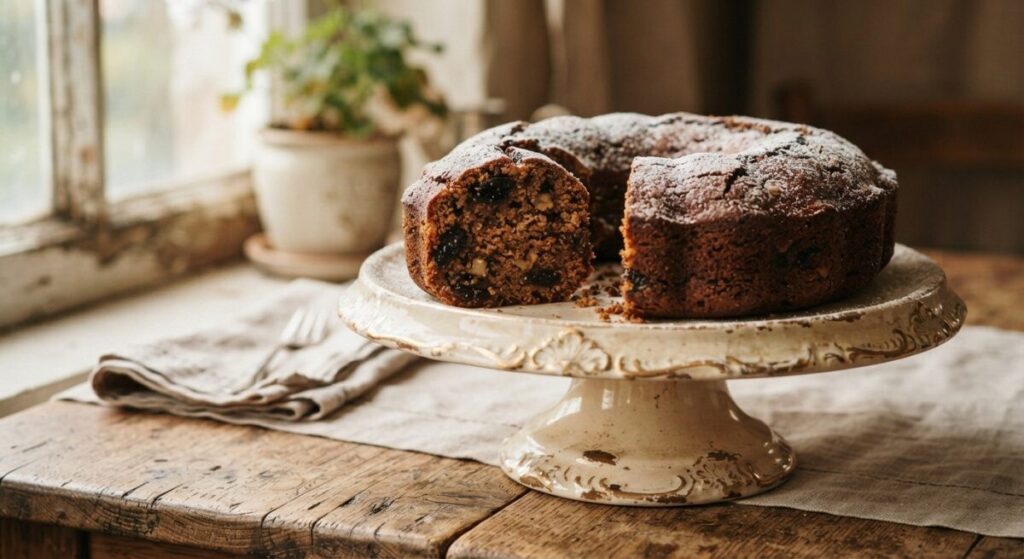
Prune cake was the dessert Depression-era cooks reached for when sugar was dear but something sweet was still needed at the end of a hard week. Dried prunes, cooked soft and folded into a spiced batter, gave the cake natural sweetness and a moistness that kept it fresh on the counter for days, with no icing required and no fuss — just a dense, fragrant cake that fills the kitchen with cinnamon and clove the moment it goes into the oven.
Jump to section
It was a dessert built on thrift disguised as indulgence. Prunes were cheap, sold dried in bulk, and kept for months in the pantry, waiting for the day a cook needed to turn a handful of basics into something special enough for Sunday dinner. Nobody at that table thought of it as a substitute for anything finer; it was simply cake, and a very good one — and I’ll admit I was surprised the first time how little it actually tastes of prunes at all, mostly just warm spice and moisture.
The Story Behind It
Dried fruit cakes have a long history in American baking, but during the Depression, prunes in particular found new popularity as an affordable way to add moisture, sweetness, and a touch of nutrition to a dessert without relying heavily on sugar or butter, both of which were watched closely in most household budgets. Prunes were often sold for a fraction of the cost of fresh fruit, kept for a long time on the shelf, and could be simmered into a soft, jammy addition to a batter with almost no effort.
Spice cakes like this one also made clever use of what a well-stocked pantry usually still had on hand: a little cinnamon, nutmeg, or clove, kept in small tins that lasted a long time because only a pinch was needed at once. Buttermilk, often left over from churning butter at home, added tang and tenderness without costing the family anything extra. The result was a cake that tasted rich and celebratory, even though it was built from some of the most economical ingredients in the house.
Ingredients
- 1 cup pitted dried prunes, chopped
- 1 cup boiling water
- 1 3/4 cups all-purpose flour
- 1 teaspoon baking soda
- 1/2 teaspoon salt
- 1 teaspoon ground cinnamon
- 1/2 teaspoon ground nutmeg
- 1/4 teaspoon ground cloves
- 1/2 cup butter, softened
- 1 cup granulated sugar
- 2 eggs
- 1/2 cup buttermilk
- 1/2 cup chopped walnuts or pecans (optional)
How to Make It
- Preheat the oven to 350°F (175°C) and grease and flour a 9-inch square or round cake pan.
- Place the chopped prunes in a heatproof bowl, pour the boiling water over them, and let them soak for 10 minutes to soften. Drain, reserving a few tablespoons of the soaking liquid, and set aside.
- In a medium bowl, whisk together the flour, baking soda, salt, cinnamon, nutmeg, and cloves.
- In a large bowl, cream the softened butter and sugar together until light and fluffy.
- Beat in the eggs one at a time, mixing well after each addition.
- Add the flour mixture to the butter mixture in three additions, alternating with the buttermilk, beginning and ending with the flour.
- Fold in the softened prunes, a splash of the reserved soaking liquid, and the nuts, if using, mixing just until combined.
- Pour the batter into the prepared pan and smooth the top with a spatula.
- Bake for 35 to 40 minutes, until a toothpick inserted in the center comes out clean.
- Cool the cake in the pan for 10 minutes, then turn it out onto a wire rack to cool completely before slicing.
Tips, Swaps & Notes
If you don’t have buttermilk, stir a teaspoon of lemon juice or vinegar into regular milk and let it sit for five minutes as a simple substitute. Dates or raisins can stand in for prunes in a pinch, though the texture and sweetness will vary slightly. Some old recipes finish this cake with a simple buttermilk glaze poured over the warm cake instead of frosting, which keeps it moist for even longer — that’s the version I make when I want to pretend I put in more effort than I actually did. Since this cake contains eggs and dairy, make sure it is baked through until a toothpick comes out clean, store the cooled cake covered at room temperature for up to three days, or refrigerate for up to a week, and avoid leaving it out in a warm kitchen for extended periods.
Why It Still Matters
This cake still matters because it turns a humble, often-overlooked pantry staple into something worth savoring, without pretending to be anything it isn’t. It’s proof that dessert doesn’t need to be extravagant to feel special, and that a resourceful cook with a bag of dried prunes and a few spices could make a Sunday dinner feel like an occasion. That kind of quiet ingenuity is worth remembering, and worth baking, long after hard times have passed.
Cut a slice while it’s still faintly warm, and you’ll understand why this humble cake earned a permanent place at the table.
Old-Fashioned Spiced Prune Cake, Moist and Nostalgic
Ingredients
- 1 1/2 cups pitted prunes
- 1 cup buttermilk, divided
- 1 1/2 cups all-purpose flour
- 1 teaspoon baking soda
- 1/2 teaspoon salt
- 1 teaspoon ground cinnamon
- 1/2 teaspoon ground nutmeg
- 1/4 teaspoon ground cloves
- 1 cup granulated sugar
- 1/2 cup vegetable oil or melted butter
- 2 large eggs
- 1 teaspoon vanilla extract
- 1/2 cup chopped walnuts or pecans (optional)
Instructions
- Preheat the oven to 350F. Grease and flour a 9-inch square or round cake pan, or a bundt pan.
- Cover the prunes with 1/2 cup of the buttermilk and simmer gently in a small saucepan for 5 minutes, or microwave to soften; cool slightly, then chop finely.
- In a bowl, whisk together the flour, baking soda, salt, cinnamon, nutmeg, and cloves.
- In a large bowl, beat the sugar and oil or butter together, then beat in the eggs one at a time and the vanilla.
- Add the flour mixture alternately with the remaining 1/2 cup buttermilk, beginning and ending with the flour, mixing just until combined.
- Fold in the chopped prunes and nuts if using.
- Pour the batter into the prepared pan and bake 35 to 40 minutes, until a toothpick inserted in the center comes out clean.
- Cool in the pan 10 minutes, then turn out onto a rack to cool completely before slicing.