Wacky Cake: The Depression-Era Cake With No Eggs or Milk
Learn to make wacky cake, the classic Depression-era chocolate cake with no eggs, milk, or butter, mixed right in the pan and still moist and rich today.

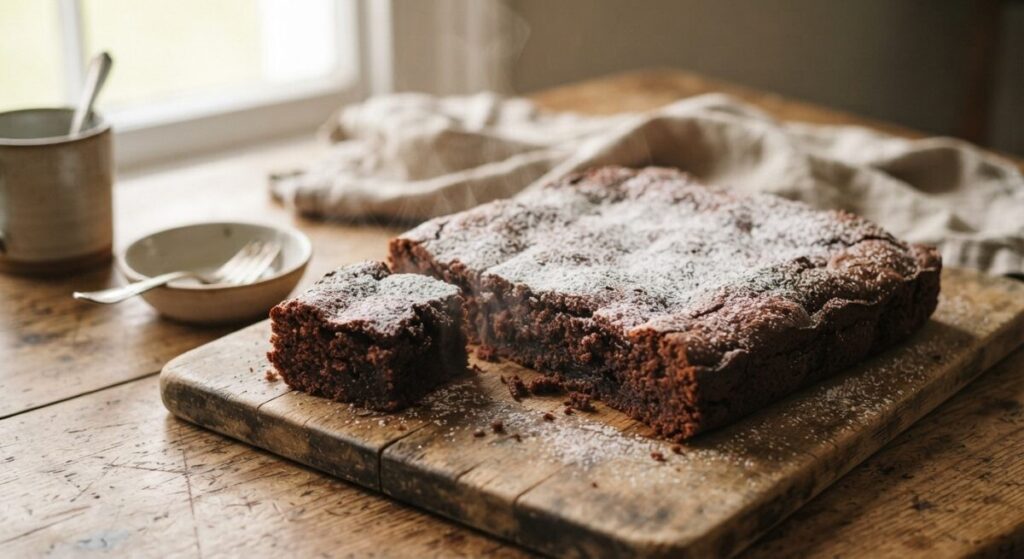
There’s a particular kind of magic in a cake that shouldn’t work but does. No eggs to bind it, no milk to enrich it, no butter to make it tender — just flour, cocoa, sugar, oil, and a fizzy little chemistry trick that made the whole thing rise. In a 1930s kitchen where a single egg might be saved for breakfast and a stick of butter felt like a small luxury, this cake was proof that dessert didn’t have to wait for better times. I still think of it as a bit of a magic trick every time I make it, and I’ve made it more times than I can count.
Jump to section
Mixed right in the pan it bakes in, with barely a dish to wash afterward, wacky cake — also called crazy cake, or simply Depression cake — comes together in minutes and tastes like something far richer than its ingredient list suggests. It’s still one of the most quietly impressive recipes to come out of that era, and it deserves a spot in a kitchen today for reasons that have nothing to do with hard times.
The Story Behind It
By the early 1930s, eggs, milk, and butter had all become things families budgeted for meals rather than desserts. But someone, somewhere, figured out that vinegar and baking soda produced enough carbon dioxide to lift a cake all on their own, the same reaction that powers a grade-school volcano. Combined with oil for moisture and cocoa for flavor, it meant a family could still have chocolate cake on a Sunday without spending a single egg or a drop of milk on it.
The cake spread through church cookbooks and handwritten recipe boxes under a dozen different names, and it earned its most common one — wacky cake — because the method looked so odd: no mixing bowl, no creaming butter and sugar, just three wells poked into a pan of dry ingredients and liquid poured in on top. It looks like a kitchen experiment. It bakes up moist, dark, and genuinely good.
Ingredients
- 1 1/2 cups all-purpose flour
- 1 cup granulated sugar
- 3 tablespoons unsweetened cocoa powder
- 1 teaspoon baking soda
- 1/2 teaspoon salt
- 1/3 cup vegetable oil
- 1 tablespoon white vinegar
- 1 teaspoon vanilla extract
- 1 cup cold water
How to Make It
- Preheat the oven to 350°F (175°C). You can grease an 8-inch square baking pan, or just leave it ungreased and bake directly in it, in the true spirit of the original recipe.
- In the baking pan, whisk together the flour, sugar, cocoa powder, baking soda, and salt until evenly combined, breaking up any cocoa clumps.
- Use a spoon to make three small wells in the dry mixture. Pour the vegetable oil into one, the vinegar into the second, and the vanilla extract into the third.
- Pour the cold water evenly over the entire pan.
- Whisk or stir the whole pan together until no streaks of flour remain and the batter is smooth. Work quickly once the vinegar and baking soda meet, since that’s what gives the cake its lift.
- Bake for 30 to 35 minutes, until a toothpick inserted in the center comes out clean and the top springs back lightly when touched.
- Cool the cake in the pan for at least 20 minutes before slicing, or let it cool completely if you plan to frost it.
Tips, Swaps & Notes
The vinegar’s job is purely chemical, not flavor — it reacts with the baking soda to create bubbles that lift the batter, and it disappears completely once baked, leaving no sour taste behind (I promise, nobody has ever guessed it’s in there). Apple cider vinegar or lemon juice work as substitutes if that’s what’s in the pantry.
A light dusting of powdered sugar is traditional and honest to the era, but a simple cocoa glaze or even a store-bought frosting works nicely if you want something a little more festive. The cake also freezes well unfrosted, wrapped tightly, for up to two months.
Don’t overmix once the wet and dry ingredients combine — a few small lumps are fine, and overworking the batter can make the crumb tougher instead of tender.
Why It Still Matters
Wacky cake has outlasted the decade that invented it because it’s simply a good cake, not just a clever one. It’s the kind of recipe worth keeping around for the nights when the fridge is nearly empty and the oven is still warm — proof that a good dessert has never really needed very much to begin with.
Some of the sweetest things in the kitchen are the ones that ask for the least.
Wacky Cake: The Depression-Era Cake With No Eggs or Milk
Ingredients
- 1 1/2 cups all-purpose flour
- 1 cup granulated sugar
- 3 tablespoons unsweetened cocoa powder
- 1 teaspoon baking soda
- 1/2 teaspoon salt
- 1/3 cup vegetable oil
- 1 tablespoon white vinegar
- 1 teaspoon vanilla extract
- 1 cup cold water
Instructions
- Preheat oven to 350°F. Have an 8-inch square or 9-inch round baking pan ready (greasing is optional if mixing directly in the pan, but makes serving easier).
- Sift the flour, sugar, cocoa powder, baking soda, and salt directly into the pan and stir together with a fork until evenly combined.
- Use a spoon to make three wells in the dry mixture. Pour the oil into one well, the vinegar into the second, and the vanilla into the third.
- Pour the cold water evenly over everything.
- Stir with a fork just until no streaks of dry flour remain and the batter is smooth; a few small lumps are fine, do not overmix.
- Bake 30-35 minutes, until a toothpick inserted in the center comes out clean.
- Cool completely in the pan on a wire rack before dusting with powdered sugar or topping with a simple glaze.