The Sunday Table: Why Slow Meals Still Matter
A warm food essay on the slow Sunday meal, the kind that waits for everyone, and why the unhurried hours it protects still matter more than the food itself.

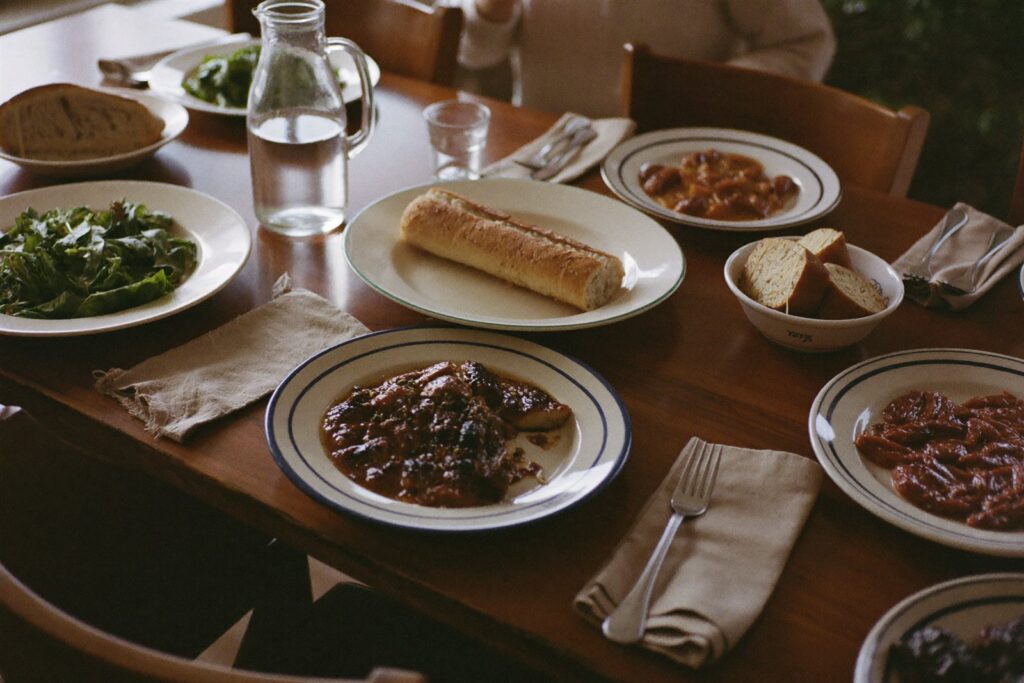
Sunday in our kitchen isn’t quiet, exactly. The radio’s usually on. Somebody’s talking too loud in the next room, and a chair scrapes the floor every so often. What actually goes quiet is the clock. On a weeknight the stove and I are racing the same deadline, and dinner has to land on the table before the evening falls apart. On Sunday the pot on the back burner calls the shots instead, and for once the day bends around the meal, not the other way around.
Jump to section
Nobody in my family called it a ritual. It was just what Sundays were: a longer lunch, more chairs pulled up to the table, something on the stove that had been given permission to take its time. I didn’t understand what those afternoons were actually protecting until I had my own cooking to run. That kind of time doesn’t happen by accident. You have to decide to keep it, on purpose, or it quietly disappears into errands and screens.
A slow dish waits for whoever’s late
A slow dish forgives you. That’s its first gift, and it’s a quiet one. A braise doesn’t punish a late arrival the way a seared steak does; it just sits there, getting better, while people wander in from wherever their afternoon took them. One from a walk. One from a nap. One from a phone call they couldn’t get off. Nobody’s standing over the stove insisting that dinner happens this exact second or it’s ruined.
That patience isn’t an accident of the dish. A pot of beans, a pork shoulder gone soft, a tray of tomatoes collapsing down in the oven: these are foods that got invented, generations back, by people who had no way of knowing exactly when everyone would actually be home. The food learned to wait. And a meal that can wait changes the mood at the table before anyone’s picked up a fork, because nobody walks in feeling like they’ve put the cook out.
What a slow meal really protects
It took me years to see this clearly: the long cooking was never really about the food. Cabbage rolls don’t turn morally superior because you hovered near the pot for two hours. The stew would taste almost as good rushed. What the slowness actually protects is the time around the food, the unhurried hours a good dish gives you an excuse to hold open.
Think about how rarely we sit at one table anymore with nowhere else to be. A slow meal is one of the last real excuses for that. You can’t rush a braise, so you stop rushing the afternoon along with it. Those hours, which would otherwise scatter into errands and scrolling, fill up instead with small talk that turns into real talk, a card game nobody planned, a kid doing homework at the end of the table while the onions go soft. The dish acts like a fence around that time. Take the dish away, and the time tends to leak out through everyone’s phones.
Cooking as a way of paying attention
Without a clock pushing you, cooking turns into something closer to noticing. You catch the exact moment the onions stop smelling sharp and start smelling sweet. You watch a sauce pull itself together and start coating the back of the spoon. You can hear the difference between a hard boil and the gentle mutter you actually wanted. None of it is hard. It just asks you to stay in the room.
People feel that attention even when they’d never think to name it. A meal cooked slowly and with some care has a quality a rushed one doesn’t, and it isn’t really about flavor. It’s the sense that somebody chose to spend their afternoon this way, on purpose, for the people who were about to sit down. That’s a kind of message. It just happens to be written in food.
It isn’t nostalgia
I want to be careful here, because this could easily sound like pining for some vanished golden age when every family sat down together nightly and nobody was ever rushed. I don’t think that age existed, and I’m not suggesting anyone move back into it. My weeks are as full as anyone’s. Most nights, dinner is a fast, honest scramble I have zero complaints about, eaten in shifts, cleared off the table in ten minutes.
The slow Sunday meal isn’t a rebuke to the weekday rush. It’s a counterweight to it. One meal a week that refuses to be hurried doesn’t ask you to romanticize the past or rebuild your whole life around it. It just wants a single afternoon, given on purpose, so the rest of the week has something to lean on. Treat it like a reward you have to earn first, and you’ll never actually get around to it.
You don’t need an occasion
The other mistake is assuming a slow meal has to be a production: a holiday, a roast, a tablecloth, a table full of guests. It doesn’t. Some of the best Sunday tables I’ve sat at held nothing fancier than a big pot of soup and decent bread. What made them slow was the time given to them, not the length of the ingredient list.
- A pot of dried beans, started in the morning with an onion, a bay leaf, and a good glug of olive oil.
- A tray of vegetables roasted low and long until the edges caramelize and catch.
- A tomato sauce left to tick over on the back burner while you get on with your day.
- Anything braised, really — the whole family of dishes that trade a little attention early for a lot of ease later.
The occasion isn’t the birthday or the holiday. The occasion is that you decided to eat together and give it some room. That’s enough. It has always been enough.
I’ve stopped treating the slow Sunday meal like a luxury I need to justify. It feels more like maintenance now, for the table and for the people who gather at it. The pot goes on the back burner in the morning. It asks for the whole day. And giving it that day, I’ve come to believe, is really just another way of giving the day to each other.