Cooking with the Seasons
Why seasonal produce tastes better and costs less, how to spot what's in season, a season-by-season guide to fruit and veg, plus easy ways to shop and cook it.

I bought strawberries in January once, for a birthday cake, because the box looked perfect: big, glossy, every berry the same photogenic red. They tasted like cold water with a faint idea of strawberry somewhere behind it, and I’d paid a small fortune for the privilege. That cake taught me more about seasonal cooking than any market has, and the lesson was plain. The fruit hadn’t done anything wrong. It had been picked hard on the far side of the world in December and asked to be something it couldn’t be in the middle of my winter. Good produce, I finally understood, isn’t only about where you shop. A lot of it comes down to when.
Jump to section
Why seasonal produce tastes better and usually costs less
There’s no magic in the word “seasonal.” A fruit or vegetable growing in its own season, near its own climate, ripens further before it’s picked, spends less time in a truck or cold store, and reaches you closer to the peak it was heading for anyway. A peach picked ripe in July and sold three days later is a different object from one picked green in winter, shipped across a hemisphere, and coaxed to color in a warehouse so it survives the trip. Both are called peaches. Only one tastes like one.
The price tends to follow the same logic. When something is genuinely in season nearby, there’s a lot of it at once (a glut), and that abundance pushes the cost down. The same item out of season is scarce, imported, and stored at somebody’s expense, and you pay for all of it. This isn’t a rule you can set your watch by; a mild year or a poor harvest scrambles it. But as a rough signal, if a vegetable is suddenly cheap and piled high, that’s the season telling you to buy it now.
How to tell what’s actually in season
You don’t need a chart taped to the fridge. Mostly it comes down to a few honest signals:
- Watch the price and the pile. When something drops in price and turns up in big, generous heaps rather than tidy little trays, it’s usually in season and local. Scarcity and season pull in opposite directions.
- Use your nose and your eyes. In-season fruit tends to smell like itself from a step away: a ripe melon, a good strawberry, a tomato with that green, stemmy scent. Out-of-season produce is often beautiful and completely odorless.
- Read the country-of-origin label. Asparagus flown in from the far side of the planet in December is not having its moment. Asparagus grown a couple of counties over in spring is.
- Let the market be your calendar. Whatever is stacked at every stall this week is, almost by definition, in season where you live.
And that last phrase, where you live, matters more than any list I could give you. Seasons don’t line up across regions: a tomato that’s a fleeting summer treat in one place grows nearly year-round in another. Treat every guide, including the one below, as a rough sketch to check against your own market.
A rough season-by-season guide
This is the pattern for a temperate, four-season climate, which is the one I cook in. Shift it to fit your own.
Spring
Spring is green and a little impatient. After a winter of roots and storage vegetables, the first tender things show up and they’re worth pouncing on: asparagus, peas, spring onions, radishes, young lettuces and leafy greens, rhubarb, and the first soft herbs. None of it keeps well or wants much done to it. A bunch of asparagus barely cooked, with butter and a squeeze of lemon, is spring on a plate.
Summer
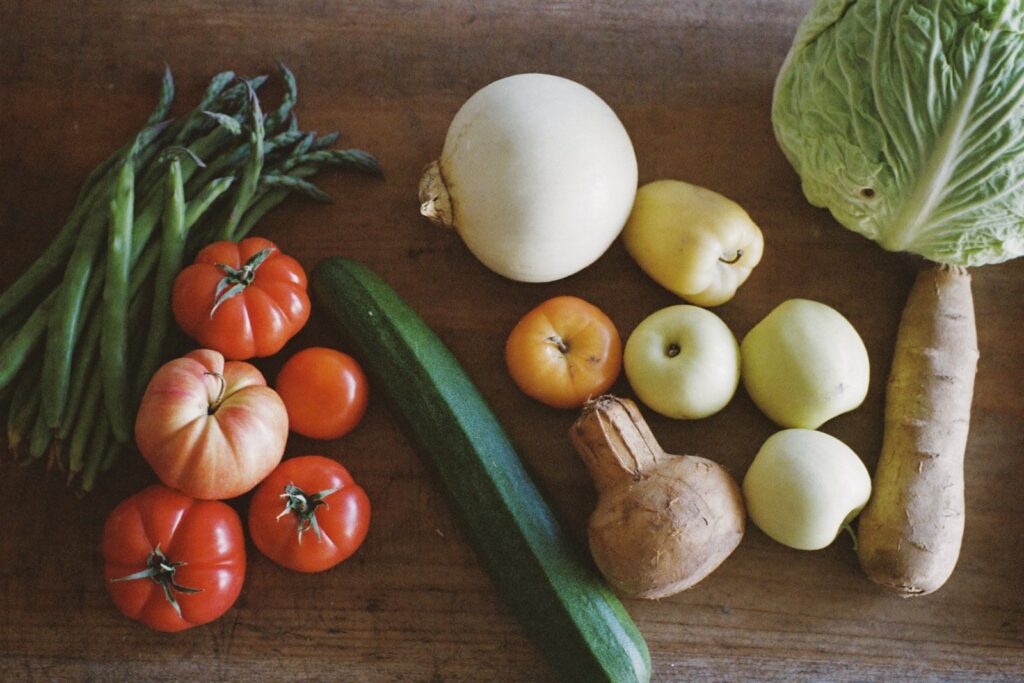
Summer is the loud season, the one where produce practically shops for you. This is the window for tomatoes, courgettes, peppers, aubergines, cucumbers, sweetcorn, beans, berries, and stone fruit like peaches and apricots. It’s also the time most worth eating raw or barely touched. A real summer tomato, sliced with a little salt and good oil, needs no recipe at all. Honestly, it resents one.
Autumn
Autumn is the harvest and the turn back toward comfort. Look for apples and pears, squash and pumpkin, mushrooms, leeks, cabbage, root vegetables, and the very last of the tomatoes. The flavors deepen and sweeten and take beautifully to roasting. This is apple season in the truest sense; a pie built now, on tart apples at their peak, is a different creature from one thrown together in spring.
Winter
Winter looks bare but isn’t. It’s the season of things that store and things that shrug off frost: potatoes, carrots, onions, beets and other roots, cabbage, kale and hardy greens, leeks, and citrus. Citrus is the quiet gift here: oranges and lemons hit their stride in the cold months, which is why so much winter cooking leans on a bright squeeze of something. This is soup and braise weather, and the storage vegetables were built for exactly this.
Simple ways to shop and cook with the seasons
None of this has to become a project or a principle you defend at dinner. A few loose habits do most of the work:
- Let the best-looking thing lead the meal. Instead of settling on a dish and then hunting down its ingredients, buy whatever looks and smells best that day and build the meal around it. The produce shouting at you is usually the produce in season.
- Shop a market at least sometimes. You don’t have to source everything there, but wandering one now and then re-teaches you what the calendar looks like, and the flavor makes its own argument.
- Cook it simply when it’s at its peak. The better the raw material, the less you should do to it. In-season vegetables reward roasting, a fast sauté, or nothing at all; save the heavy sauces for the times of year when the produce needs the help.
- Buy extra when it’s cheap. When something is everywhere and costs almost nothing, get more than one meal’s worth and put some away for later.
That last habit is worth its own moment.
What to do with a glut
A glut is a gift wearing the costume of a problem: twenty tomatoes ripening on the same afternoon, more courgettes than a household can face, a bag of apples going soft. Rather than watch it turn, tuck a bit of summer or autumn into a jar or the freezer:
- Freeze what freezes well. Berries on a tray, then bagged once solid; roasted tomatoes; blanched beans and greens. Most keep their character for months.
- Cook it down. A glut of tomatoes becomes a batch of sauce; soft apples become a pot of compote or the filling for a pie. Concentrating the flavor is a kind of storage in itself.
- Pickle or preserve. Cucumbers, cabbage, beans, and firm vegetables take happily to a jar of brine or vinegar, handing you something bright and sharp to eat when the fresh stuff runs thin.
Do this even a few times a year and a little of the good season carries into the lean one, usually the cheapest food you’ll put up all year.
Frequently asked questions
Do I have to cook seasonally all the time?
Not at all, and I don’t. Seasonal cooking is a habit that pays off, not a test you pass or fail. Lean into it when produce is at its peak and cheap, and don’t feel a scrap of guilt about the out-of-season lemon or the frozen peas that rescue a weeknight. It’s a lean, not a law.
Is seasonal produce always cheaper?
Usually, but not without exceptions. In-season produce comes in a glut, and abundance drags the price down. A bad harvest, a heatwave, or a genuine specialty item can scramble that. The most reliable signal is the pile: when a vegetable is cheap and stacked high, that’s the moment to buy.
How do I know what’s in season where I live?
Your local market is the most honest calendar there is: whatever’s abundant and cheap there this week is almost certainly in season nearby. General guides give you the shape of it, but seasons shift by region and climate, so check any chart against what you see and smell at the stalls closest to home.