Garlic Honey Ferment: Does the Jar Do Anything?
Garlic honey is a traditional cold-season jar of raw garlic and honey. See what the evidence really supports, how it is made, and how to use it safely.

A quick note: this is a traditional home remedy shared for general interest — not medical advice. See our medical disclaimer, and please see a doctor for severe, worsening, or persistent symptoms.
Jump to section
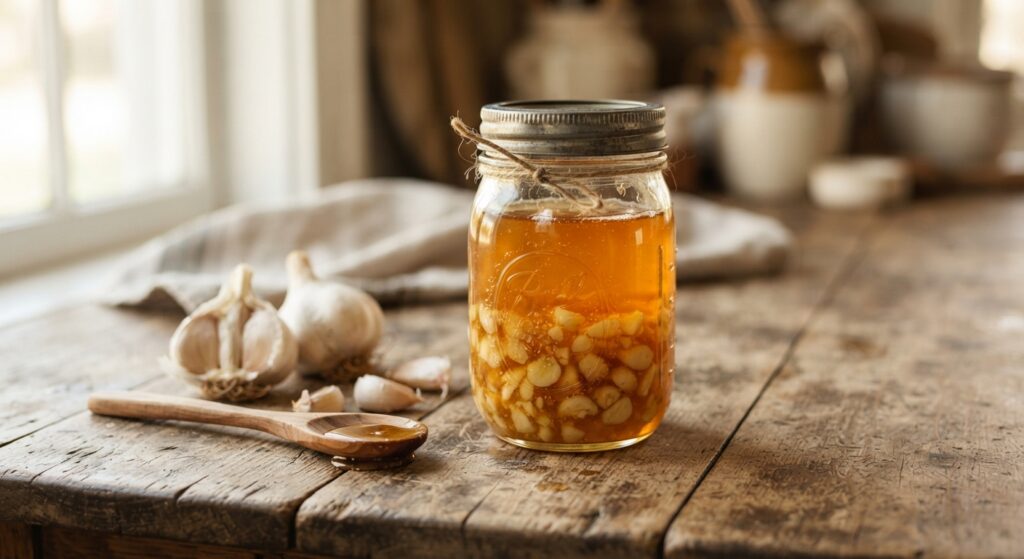
I keep a jar of garlic steeped in honey on my counter every winter, and it looks like nothing — just cloves going soft and golden under honey that’s turned faintly garlicky. Households across Eastern Europe, the Middle East, and parts of Asia have kept a version of this jar around for cold season, sore throats, and that run-down feeling winter brings. It was never hospital medicine. It was just what was on the shelf.
Why people keep making it
Part of the appeal is the ritual, honestly. Garlic’s been used in folk medicine for thousands of years, and raw honey has just as long a history as something soothing for a scratchy throat. Combine them and let time do its work, and tradition says you end up with something gentler on the stomach than raw garlic alone, and more interesting than a spoon of plain honey. People reach for a spoonful at the first hint of a sore throat or the first day of a cold, hoping to feel a little better while it runs its course.
What the research actually shows
Garlic contains allicin, a sulfur compound that forms when raw garlic is crushed, and it’s one of the more studied plant compounds out there. In lab and test-tube research, allicin and other garlic compounds show antibacterial, antiviral, and antifungal activity against microbes in a dish. Raw honey has very low water content and forms small amounts of hydrogen peroxide, which is why some lab studies suggest it slows certain microorganisms too.
What I can’t honestly tell you is that eating garlic honey clears an infection in your body. Most of those promising results come from lab settings, not careful human trials, and what happens in a petri dish often doesn’t carry over once food gets eaten and digested. There’s some limited human evidence that garlic supplements modestly cut down how often people catch colds, but those studies are small. I think of garlic honey as a traditional comfort with a plausible backstory — not a treatment.
How I make it
Peel and lightly crush the cloves from a whole head of garlic, put them in a clean glass jar, and cover them completely with raw honey. Keep the lid loose, or open the jar daily, so gases from fermentation can escape, and stir it gently each day so every clove stays coated. After three to four weeks at room temperature the garlic softens and the flavor mellows. Traditionally, people take one clove and a small spoonful of the honey when a cold is coming on.
- Keep the garlic fully submerged the whole time — cloves left exposed to air can spoil.
- Use a clean utensil each time you dip in, and toss the batch if you see fuzzy mold, an off smell, or an odd color.
- Garlic stored in honey or oil carries a rare risk of botulism, so keeping everything clean and refrigerating the jar is the cautious move.
Who should skip it, or ask first
Never give honey to a baby under one year old — the risk is infant botulism, full stop. Garlic can thin the blood, so if you’re on blood thinners, heading into surgery, or living with a bleeding disorder, check with your doctor before you start eating it by the spoonful. Large amounts of raw garlic can also cause heartburn, an upset stomach, or irritation for some people, and anyone allergic to garlic or bee products should leave it alone entirely.
Most colds and sore throats ease up on their own within a week or so. See a doctor if you have a high fever, a severe or one-sided sore throat, trouble swallowing or breathing, a stiff neck, or symptoms lasting more than a few days or getting worse. A spoonful from the pantry doesn’t substitute for care when something more serious is brewing.
Garlic honey is cheap, easy, and genuinely pleasant, with a real basis in lab science and no proven power to treat illness in actual people. Made cleanly, with realistic expectations, it’s a nice ritual for cold season — a spoonful of folklore, not a medicine.
This article is for general educational purposes only and is not medical advice. Traditional remedies are not a substitute for professional care. If your symptoms are severe, persistent, or getting worse, please consult a qualified healthcare provider.
Health disclaimer: This article describes a traditional folk remedy for general information only. It is not medical advice and is not a substitute for professional diagnosis or treatment. Some remedies can cause irritation, allergic reactions, or interact with medications. Consult a qualified healthcare professional before trying any remedy, patch-test anything applied to skin, and seek prompt medical care for severe, worsening, or persistent symptoms. See our full Medical Disclaimer.
Garlic Honey Ferment: Does the Jar Do Anything?
Ingredients
- 1 head of garlic (about 10-12 cloves), peeled
- raw honey, about 1 cup, enough to cover
Instructions
- Peel the garlic cloves and lightly crush each one.
- Place the cloves in a clean, dry glass jar.
- Pour raw honey over the garlic until fully submerged, leaving an inch of headspace.
- Cap loosely, since fermentation releases gas, and keep at room temperature away from light.
- Turn the jar daily for the first week so every clove stays coated.
- Let it ferment 3 to 4 weeks; it is ready when the honey thins and the garlic mellows.