Onion Poultice for Chest Colds: What It Actually Does
The onion poultice is a warm folk compress for chest colds. Learn what tradition claims, what evidence shows, plus safety tips and when to see a doctor.

A quick note: this is a traditional home remedy shared for general interest — not medical advice. See our medical disclaimer, and please see a doctor for severe, worsening, or persistent symptoms.
Jump to section
My grandmother used to warm a crushed onion, wrap it in a dish towel, and press it against my chest whenever I had a bad cough. I hated the smell for days afterward. It was a fixture of home care across Russia, Germany, and much of Eastern Europe — reached for during chest colds, coughs, and the heavy congestion of a winter bug. Nobody ever treated it as a replacement for a doctor. It was just a warm, hands-on comfort families kept passing down.
Why anyone bothered with a raw onion
A poultice is just a soft, warm mass held against the skin, and the onion version leans on two things: gentle heat and a strong smell. The old thinking was that warmth eased a tight, achy chest while the onion’s fumes made a stuffy nose and heavy chest feel a bit clearer. Some versions went on the feet overnight, under wool socks, on the belief that the feet were a doorway to the rest of the body. The comfort part is real. The rest is worth a skeptical look.
What actually holds up
Onions are in the same family as garlic and carry plenty of sulfur compounds and antioxidants like quercetin. In lab research, those compounds show anti-inflammatory activity, and some test-tube studies suggest they slow the growth of certain microbes. Interesting, sure — but it’s a long way from proof that vapor off a warm onion sitting on your chest can reach your airways and do anything measurable to an infection inside them.
There’s little to no formal human research on onion poultices specifically, and nothing showing they shorten a cold or clear up a chest infection. What they plausibly give you is the same thing any warm compress gives you: a little heat, and the subjective sense of breathing easier that a lot of people get from a strong smell. I’d treat it as a comforting ritual layered on top of rest and fluids, not a remedy for the illness itself.
How to actually do it
This stays external. Don’t eat the onion as a treatment, and never push it into the nose or apply it to broken skin.
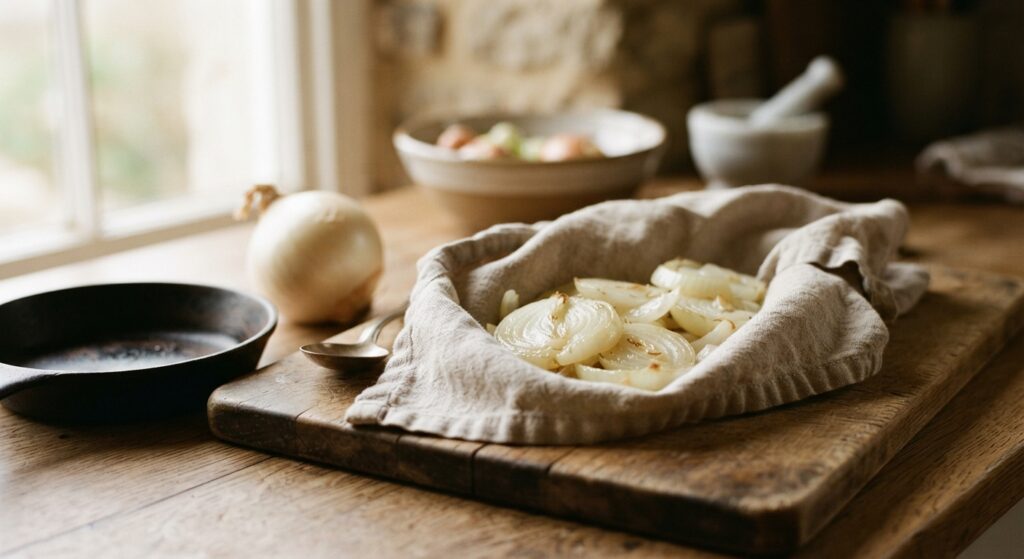
- Chop or crush one or two onions and warm them gently in a dry pan until just warm to the touch — never hot.
- Wrap the onion in a clean cloth or tea towel so it forms a flat parcel, with no onion touching the skin directly.
- Test the temperature on your inner forearm first, then rest the parcel on the chest for 20 to 30 minutes, or wrap it against the soles of the feet under socks.
- Take it off if the skin turns red, itchy, or irritated, and always keep cloth between the onion and the skin.
Where to be careful
Onion juice can irritate skin, so patch-test on the inner arm first, especially for kids and anyone with sensitive skin. With young children, keep it warm rather than hot to avoid burns, never leave a child unattended with it, and stop at the first sign of discomfort. Skip it entirely if you’re allergic to onion or other alliums.
Know when a poultice isn’t enough. Get medical care for a high or persistent fever, difficulty breathing or rapid breathing, chest pain, bluish lips, coughing up blood, wheezing, or a cough that drags on past a couple of weeks or keeps getting worse. Chest symptoms in babies, older adults, or anyone with asthma, a chronic lung condition, or a heart condition need prompt professional attention, not home care alone.
An onion poultice won’t touch the infection. It’ll warm you up and give you something to do besides lie there coughing, which on a rough night is worth something. Keep it external, keep it warm rather than hot, and let it sit alongside proper rest — not instead of it.
This article is for general educational purposes only and is not medical advice. Traditional remedies are not a substitute for professional care. If your symptoms are severe, persistent, or getting worse, please consult a qualified healthcare provider.
Health disclaimer: This article describes a traditional folk remedy for general information only. It is not medical advice and is not a substitute for professional diagnosis or treatment. Some remedies can cause irritation, allergic reactions, or interact with medications. Consult a qualified healthcare professional before trying any remedy, patch-test anything applied to skin, and seek prompt medical care for severe, worsening, or persistent symptoms. See our full Medical Disclaimer.