Old-Fashioned American Goulash: A Depression-Era Comfort Meal
Make old-fashioned American goulash, the one-pot Depression-era dinner of ground beef, macaroni, and tomato sauce that still feeds a hungry family fast.

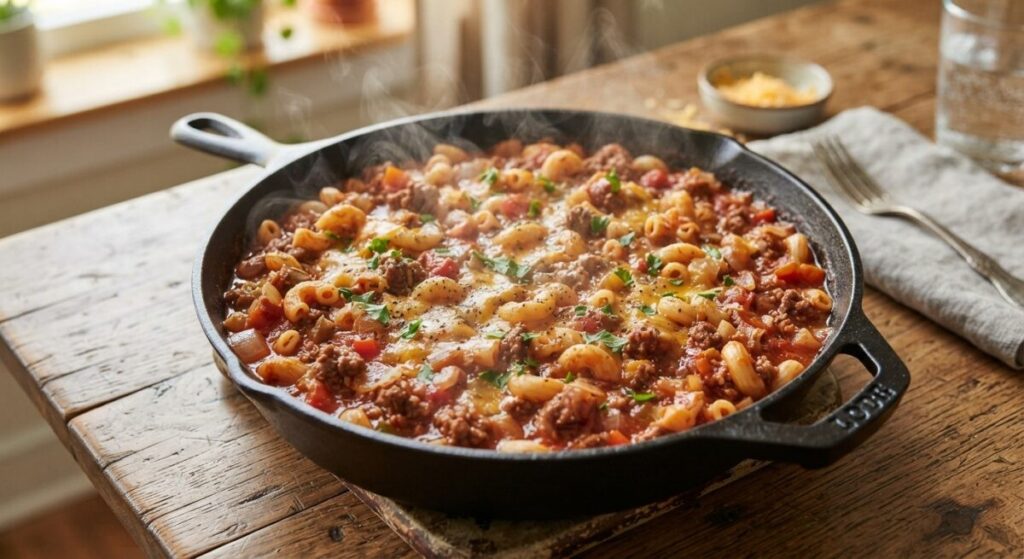
My kitchen fills with that same smell every time I make goulash — tomatoey, a little garlicky, thick with macaroni and browned beef, the kind of steam that means nothing here is going to waste. During the Great Depression, a single pound of ground beef had to feed a family of five or six, and American goulash was one of the clever, one-pot answers: stretch the meat with pasta and a can of tomatoes, season it well, and let the pot do the rest.
Jump to section
I’ll say this up front: it isn’t the Hungarian dish it borrows its name from, and it was never trying to be. This is a practical, everyday skillet supper built from whatever cheap, shelf-stable ingredients a family could gather — ground beef when it was affordable, macaroni because it cooked quickly and filled plates, and tomatoes because a can or jar of them turned plain starch into something saucy and satisfying. One pot, one burner, barely any cleanup, which is exactly why it’s still what I reach for on a weeknight when time and money both feel tight.
The Story Behind It
Immigrant cooking traditions and American frugality merged somewhere in the early twentieth century to create this loose, tomato-based skillet dish, and it took firm hold during the lean years of the 1930s. Ground beef was one of the cheaper cuts a family could buy, and pairing it with dried macaroni meant a single pound could easily stretch to feed a full table. Canned tomatoes, already a pantry staple in many homes, added acidity and body without requiring fresh produce that might be scarce or expensive depending on the season. Cooks passed their own versions down through generations, some adding a spoonful of sugar to soften the tomatoes’ bite, others tossing in whatever vegetables needed using up — which is probably why I’ve never made it exactly the same way twice, and why no two family recipes for goulash have ever quite matched.
Ingredients
- 1 pound ground beef
- 1 small onion, diced
- 1 clove garlic, minced (optional)
- 2 cups elbow macaroni, uncooked
- 1 can (28 ounces) diced or crushed tomatoes
- 1 cup water or beef broth
- 1 tablespoon Worcestershire sauce, if on hand
- 1 teaspoon paprika
- 1 teaspoon salt, or to taste
- 1/2 teaspoon black pepper
- 1 bay leaf, if available
How to Make It
- I start the ground beef and onion together in a large, deep skillet or Dutch oven over medium heat, breaking up the meat as it cooks, until the beef is browned through and the onion is soft, about 7 minutes. Drain off the excess fat.
- Stir in the garlic and let it cook for 30 seconds, just until fragrant.
- Add the tomatoes, water or broth, Worcestershire sauce, paprika, salt, pepper, and bay leaf. Stir well and bring it to a simmer.
- Stir in the uncooked macaroni, making sure it’s mostly submerged in the liquid.
- Cover and simmer over low heat for 15 to 18 minutes, stirring occasionally, until the macaroni is tender and has soaked up most of the liquid.
- Pull out the bay leaf, taste and adjust the seasoning, and let the goulash rest for 5 minutes before serving — it thickens a bit more as it sits.
Tips, Swaps & Notes
Cook the ground beef all the way through to a safe internal temperature before adding anything else, so don’t rush that first step. If the goulash looks too thick as it simmers, splash in a little extra water or broth; if it’s too thin, uncover it for the last few minutes of cooking. I like stirring in a handful of shredded cheddar at the end, and diced bell pepper or a can of corn are easy ways to use up produce sitting in the fridge — that’s usually how mine ends up a little different from the last batch. Refrigerate leftovers within two hours of cooking and use within 3 to 4 days; honestly, it tastes even better the next day.
Why It Still Matters
American goulash has stayed on family tables for nearly a century because it does exactly what it was built to do: turn a little meat and a lot of pantry staples into a filling, satisfying meal with almost no fuss. It’s a dish built for busy nights and tight budgets, and it still delivers exactly the kind of comfort it always has — warm, hearty, and made to feed everyone at the table.
It was never a fancy supper, just an honest one — and somehow, that always tasted like home.
Old-Fashioned American Goulash: A Depression-Era Comfort Meal
Ingredients
- 1 1/2 pounds ground beef
- 1 medium onion, diced
- 2 cloves garlic, minced
- 2 cans (14.5 oz each) diced tomatoes
- 1 can (8 oz) tomato sauce
- 2 cups elbow macaroni, uncooked
- 1 cup water or beef broth
- 1 tablespoon Worcestershire sauce
- 1 teaspoon dried Italian seasoning
- 1 teaspoon sugar
- Salt and black pepper, to taste
- Shredded cheddar cheese, for serving (optional)
Instructions
- In a large pot or Dutch oven over medium-high heat, brown the ground beef with the onion, breaking up the meat, until the beef is cooked through; drain excess fat.
- Add the garlic and cook 1 minute, until fragrant.
- Stir in the diced tomatoes, tomato sauce, water, Worcestershire sauce, Italian seasoning, and sugar.
- Bring to a simmer, cover, and cook 10 minutes to blend the flavors.
- Stir in the uncooked macaroni, cover, and simmer 12-15 minutes, stirring occasionally, until the pasta is tender.
- Season with salt and pepper to taste.
- Top with shredded cheddar if desired and serve hot.