A Stronger Saltwater Gargle for an Early Sore Throat
A warm saltwater gargle with a little vinegar and turmeric may soothe an early sore throat. Here is how to use it safely and what the evidence really shows.

A quick note: this is a traditional home remedy shared for general interest — not medical advice. See our medical disclaimer, and please see a doctor for severe, worsening, or persistent symptoms.
Jump to section
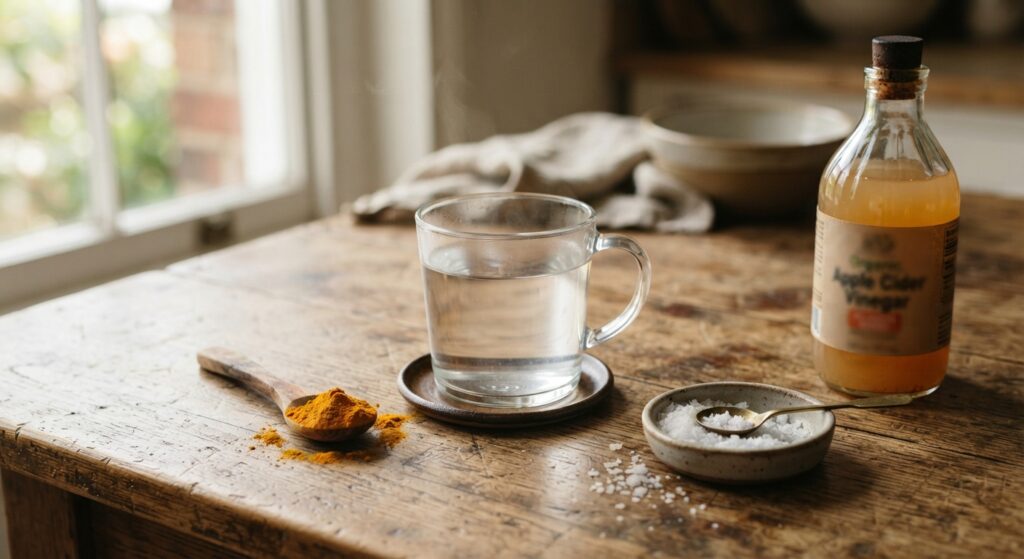
Salt water is the sore-throat remedy nobody has to be taught. It just gets passed down. But the version my grandmother’s generation used was a little stronger than the plain glass most people remember: a splash of raw apple cider vinegar and a pinch of turmeric stirred in. Not a cure, never was. Just something to make the first raw, scratchy day of a sore throat a bit more bearable.
Where the idea comes from
Salt water gargling goes back a long way. Greek physicians wrote about sea-salt rinses centuries ago, and gargling with salt water has been a folk standby for throat and mouth discomfort ever since, with a long history behind it. The logic is plain osmosis: a concentrated salt solution pulls fluid out of swollen tissue, which is why the puffy, raw feeling in your throat eases for a while after gargling. The vinegar and turmeric came later, folk additions each meant to pull their own weight.
What actually holds up
Salt water itself is one of the better-supported home measures for a sore throat. A few small human studies, including on regular saltwater gargling during upper-respiratory infections, suggest it may modestly ease symptoms, and it’s very unlikely to do harm. That’s a real, if modest, claim.
The extras are on shakier ground. Turmeric’s curcumin shows anti-inflammatory activity in lab studies, but almost all of that is in cells or animals, not in people gargling with it, and curcumin doesn’t absorb well to begin with. Vinegar is acidic, and acidic conditions are inhospitable to some microbes in a dish, but there’s little actual research on vinegar gargles specifically. So the salt is doing the real work. The vinegar and turmeric are traditional add-ons that may make some people feel a bit better, nothing more definite than that.
How to make it
- Dissolve half to one teaspoon of salt in a glass (8 ounces) of comfortably warm water.
- Stir in a teaspoon of raw apple cider vinegar and a small pinch of turmeric, if you’re using them.
- Tilt your head back, gargle for 20 to 30 seconds, then spit it out.
- Repeat a few times a day, mixing a fresh glass each time.
One rule matters more than the rest: gargle and spit, never swallow. Swallowed salt water is unpleasant and can upset your stomach. And because the whole thing depends on gargling properly, it isn’t something for young children who can’t reliably spit instead of swallow.
A few cautions, and when to stop gargling and call someone
For most healthy adults this is low-risk. If the vinegar stings sensitive gums or mouth sores, skip it or dilute further. Watch your sodium if you’re on a restricted diet, even though you spit it out. Turmeric stains everything it touches, so protect your sink and shirt.
A gargle is comfort, not treatment. See a doctor if the sore throat is severe, comes with a high fever, makes it hard to swallow or breathe, brings drooling, a stiff neck, or swelling on one side, or lasts more than a few days without easing. A very painful throat with fever can be strep or something else that needs an actual diagnosis and sometimes a prescription.
A warm saltwater gargle, vinegar and turmeric or not, is a cheap, time-tested way to take the edge off an early sore throat. It buys you a little comfort in the first day or two. It doesn’t buy you out of seeing someone if things get worse.
This article is for general educational purposes only and is not medical advice. Traditional remedies are not a substitute for professional care. If your symptoms are severe, persistent, or getting worse, please consult a qualified healthcare provider.
Health disclaimer: This article describes a traditional folk remedy for general information only. It is not medical advice and is not a substitute for professional diagnosis or treatment. Some remedies can cause irritation, allergic reactions, or interact with medications. Consult a qualified healthcare professional before trying any remedy, patch-test anything applied to skin, and seek prompt medical care for severe, worsening, or persistent symptoms. See our full Medical Disclaimer.