The Recipe Card That Outlived Three Kitchens
A worn card with a few words and no real instructions, and everything it still takes to keep a grandmother's walnut roll alive across three kitchens.

The card is about the size of my hand, and soft at the corners in the way paper only gets when it has been handled for decades instead of years. The ink has gone brown. Near the bottom one word has nearly vanished, worn away by a thumb — my grandmother’s thumb — pressing the same spot a thousand times while she read something she already knew by heart.
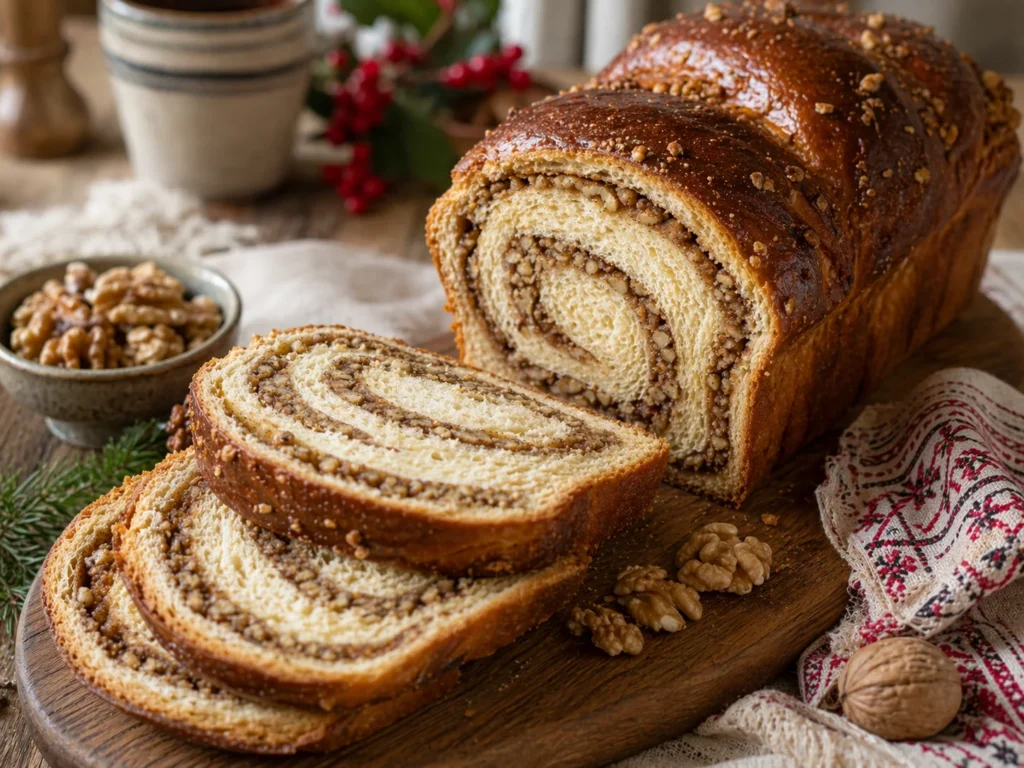
It is a recipe for a walnut roll, and it is very nearly useless to anyone who didn’t already know how to make one. Flour, yeast, butter, sugar, eggs, a small mountain of ground walnuts. A few amounts, some of them crossed out and written again in a smaller hand. And then, for the actual making of the thing, almost nothing. “Work the dough until it’s right.” “Bake till it smells done.” That’s the recipe. That is the whole of the inheritance.
Why old family recipes leave out the instructions
For a long time those gaps annoyed me. I wanted the missing numbers: the oven temperature, the minutes, the cups leveled off with a knife. It felt like being handed a map with the roads left off. Only later did I understand that the gaps weren’t carelessness. They were the parts my grandmother never needed to write down, because they didn’t live on the card. They lived in her hands.
“Until it’s right” meant something exact to her. She knew the feel of the dough at the moment it had been kneaded enough: springy, a little tacky, warm from her palms. She knew “smells done” as a specific instant, the point where the toasted-walnut smell tipped over into something rounder and the whole kitchen quietly announced it. That knowledge wasn’t written because it couldn’t be. It could only be handed over the way she had received it herself — by standing next to someone at the counter, close enough to watch their hands and copy them.
A recipe card that lived in three kitchens
The card has outlived three kitchens now, and I can picture all of them.
The first was my grandmother’s: small and warm, a window over the sink that fogged in winter. The card lived propped against the flour tin, though I rarely saw her look at it. The second was my mother’s, a brighter kitchen a long drive away, where the card arrived in a shoebox of papers after my grandmother died and then sat in a drawer for a couple of years before anyone felt ready to use it. The third is mine, where it lives now, held to the side of a cabinet by a magnet, gone a little translucent with age and butter.
Each of those kitchens had a different oven, a different climate, a different bag of flour. The recipe survived all of it — not by staying identical, but by bending. My mother baked the roll a shade darker than her mother had. I’ve learned my oven runs hot and pull mine sooner. The card stayed the same; the roll it produces has quietly changed in every kitchen it passed through. Somehow that feels less like the recipe drifting and more like it doing exactly what it was built to do.
Learning it with my hands
The first time I tried to make the roll on my own, I failed in all the ordinary ways. The dough was too wet, then too dry once I overcorrected. I rolled it too thick. The filling tore through in one spot and leaked dark and sweet onto the pan. It smelled wonderful and looked like a mistake.
What fixed it wasn’t finding a better-written version online, though I did look. It was making it again. And again. Somewhere around the fourth or fifth try, my hands began to know things my head had never managed to memorize: when to stop adding flour, how firmly the dough should push back, how thin to coax it before the walnuts went on. I wasn’t following the card anymore. I was doing the thing the card had always assumed I’d been taught. For the first time, “until it’s right” meant something to me too.
The things a card can’t hold
I won’t pretend nothing was lost along the way. My roll is not my grandmother’s roll. I never stood at her counter long enough as a child, and by the time I wanted to, she was gone. There are gestures in that recipe I’ll never recover because the only copy of them was in a pair of hands that no longer exist. A card can carry the shape of a dish. It cannot carry the person.
But it can carry enough. It can carry the reason to try, and a rough outline to try against, and a name for the thing you’re reaching for. When my kitchen fills with that particular smell in December, some part of her afternoon is happening again in mine. Not perfectly. Not identically. But truly enough that it counts.
Keeping a family recipe alive
I’ve come to think the worst thing you can do with a handed-down recipe is treat it like a museum piece — too precious to touch, cooked once a year with anxious reverence. That is how recipes actually die. They survive by being made often enough to become yours, changes and all.
So I’ve started doing the thing my grandmother didn’t. I write things down. Not to replace her card, which stays exactly as it is, but on a page of my own, tucked beside it:
- What the dough should feel like under my hands, in plain words I’ll understand at midnight before a holiday.
- My oven’s real temperature, and the minute the smell changes.
- The year I used too many walnuts and it was, honestly, better.
- Who was in the kitchen the time it came out just right.
None of that is on the original. All of it is part of the recipe now. I like to think I’m doing for some future kitchen what my grandmother did for mine: leaving just enough on paper, and trusting the rest to a pair of hands that haven’t learned it yet. The card will outlive my kitchen too, most likely. It will go soft at a few more corners and lose another word or two to someone’s thumb. And if it’s lucky, it will keep meaning what it has always meant — not a set of instructions, but an invitation to stand at the counter beside someone and learn the parts that were never going to fit on a card.
The information on Kepoli is provided for general informational purposes only and is not professional medical, health, nutritional, or safety advice. Always use your own judgment and consult a qualified professional before acting on it.