Old-Fashioned Thrifty Slow-Simmered Beef Stew Recipe
Tender chuck beef and root vegetables simmer for hours into a rich, thrifty old-fashioned stew, a Depression-era classic that feeds a family from one pot.

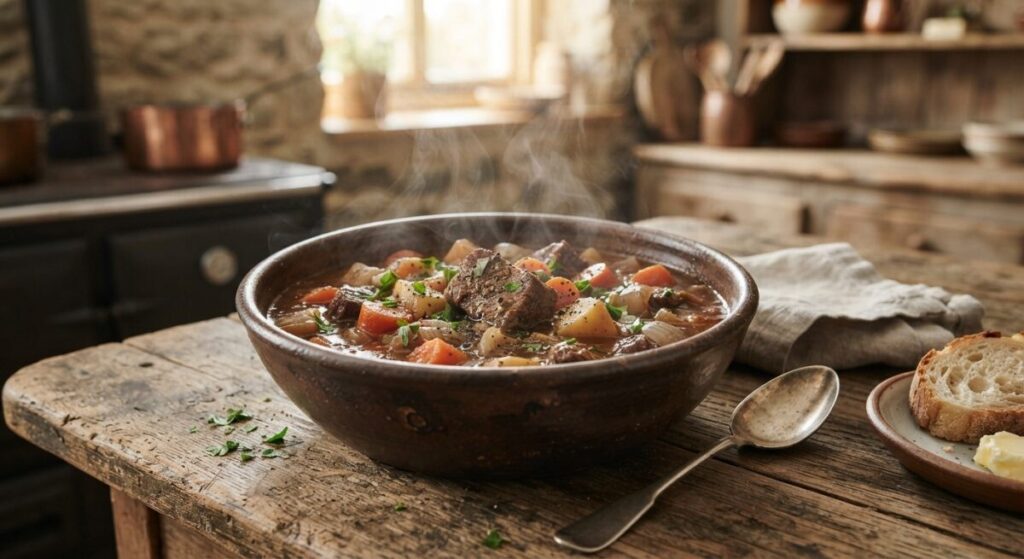
A pot of beef stew simmering low on the back burner has a way of announcing itself before you even walk through the door — onions softening, broth deepening, a chuck roast slowly giving up its toughness for something rich and tender. It is not a quick meal, and it was never meant to be. Old-fashioned beef stew rewards patience with a dinner that stretches a small amount of meat into a full, satisfying pot.
Jump to section
During the Great Depression, beef stew was a lesson in making the most of the cheapest cuts available. A pound or two of tough, inexpensive beef, simmered for hours with root vegetables from the cellar, could feed a family for two or three meals. Nothing about it was wasteful. Bones went into the pot for flavor, vegetables that were slightly past their best still found their way in, and the long, slow cooking did all the work of turning scraps into supper.
The Story Behind It
Long before slow cookers existed, home cooks relied on a heavy pot and a low flame to transform cheap, tough cuts of beef — chuck, shank, or round — into something tender enough to eat with a spoon. These cuts cost far less than steak because they needed time, not money, to become good. Root vegetables like potatoes, carrots, onions, and turnips were inexpensive, stored well through winter, and bulked out the stew so that a small amount of meat could feed a large family. A simple flour-thickened broth pulled everything together into something hearty enough to be a full meal on its own, often served with bread to mop up every last bit of gravy. It was, in every sense, a dish designed to make little go a long way.
Tips, Swaps & Notes
Chuck roast is ideal because the marbling breaks down into tenderness over a long simmer, but shank or round can be used as well with a slightly longer cooking time. Turnips or parsnips make a fine addition or substitute for some of the potatoes, echoing the cellar vegetables of decades past. A splash of vinegar or a spoonful of tomato paste added early on deepens the flavor nicely. Because this stew contains beef, always cook it until fully tender and no longer pink before serving. Leftovers keep well in the refrigerator for three to four days and often taste even better the next day, once the flavors have had time to settle.
Why It Still Matters
Beef stew remains one of the smartest meals a home cook can make when money is tight. It turns inexpensive cuts of meat into something tender and satisfying, uses vegetables that are easy to keep on hand, and feeds a family generously from a single pot. There is no shortcut to its flavor — just time, a low flame, and ingredients that have always been affordable. That simplicity is exactly why it has stayed on dinner tables for nearly a century.
Some meals just need time, a warm kitchen, and a good loaf of bread waiting on the counter.
Old-Fashioned Thrifty Slow-Simmered Beef Stew Recipe
Ingredients
- 2 lbs beef chuck roast, cut into 1 1/2-inch cubes
- 1/4 cup all-purpose flour, plus 2 tablespoons
- 2 tablespoons vegetable oil
- 1 large onion, chopped
- 3 cloves garlic, minced
- 6 cups beef broth
- 1 tablespoon tomato paste
- 4 medium potatoes, peeled and cubed
- 4 carrots, peeled and sliced
- 2 celery stalks, sliced
- 1 bay leaf
- 1 teaspoon dried thyme
- Salt and black pepper, to taste
Instructions
- Season the beef with salt and pepper, then toss with 1/4 cup flour to coat.
- Heat the oil in a large heavy pot over medium-high heat and brown the beef in batches, about 3-4 minutes per side; set aside.
- Add the onion to the pot and cook until softened, about 5 minutes, then add the garlic and cook 1 minute more.
- Stir in the tomato paste and cook 1 minute, then return the beef to the pot.
- Add the broth, bay leaf, and thyme, bring to a simmer, cover, and cook over low heat for 1 1/2 hours, stirring occasionally.
- Add the potatoes, carrots, and celery, and continue simmering, covered, for another 45 minutes to 1 hour, until the meat and vegetables are tender.
- Mix the remaining 2 tablespoons flour with a little cold water to make a slurry, stir into the stew, and simmer uncovered for 10 minutes to thicken.
- Discard the bay leaf, taste and adjust seasoning, and serve hot with bread.