Old-Fashioned Johnny Cakes (Cornmeal Griddle Cakes)
Learn to make old-fashioned johnny cakes, crispy cornmeal griddle cakes from Depression-era kitchens. Just a few pantry staples for a warm, nostalgic breakfast.

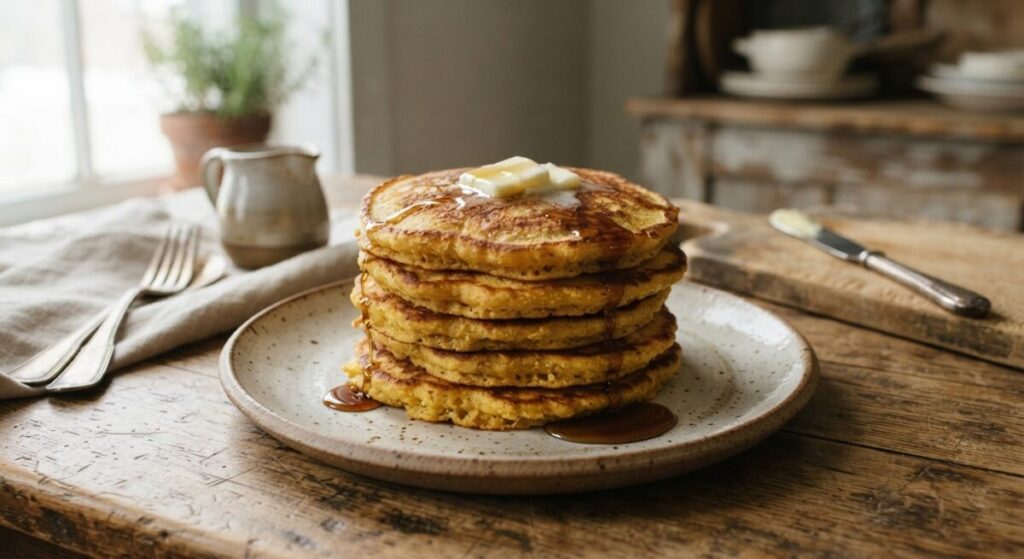
Before pancake mix ever came in a box, my family made johnny cakes — a stack of golden cornmeal griddle cakes crackling in bacon fat on the stove, ready before the coffee even finished perking. I still make them the same lazy way: no yeast, no rising time, and honestly, no real measuring once you get a feel for it.
Jump to section
During the hardest years of the Depression, when wheat flour was often rationed by the household budget rather than any government program, cornmeal carried entire families through the week. Johnny cakes asked for precious few ingredients — just meal, water or milk, a little fat, and a hot griddle. They were the kind of food a tired cook could make from memory, in the dark, without measuring a thing.
The Story Behind It
Johnny cakes have roots stretching back to Native American cornmeal cooking, adopted and adapted by early American settlers who had corn in far greater supply than wheat. The name itself has a foggy history — some say it began as a “journey cake,” a flat cornmeal bread that travelers carried because it kept well, while others trace it to New England traditions of stone-ground cornmeal griddle cakes passed down through generations.
By the Depression years, the exact origin of the name mattered less than the fact that cornmeal was one of the last pantry staples a family would let run out. It was grown widely, milled locally, and priced within reach even when nearly everything else wasn’t. A griddle full of johnny cakes could be stretched thin to feed more mouths, sweetened with a little molasses when there was some to spare, or served plain with nothing more than a smear of butter, if butter could be found at all.
Ingredients
- 1 cup cornmeal, preferably stone-ground
- 1/2 teaspoon salt
- 1 tablespoon sugar or molasses (optional)
- 1 cup boiling water
- 1/2 cup milk, or more for a thinner cake
- 1 egg (optional, for a lighter texture)
- 2 tablespoons bacon drippings, lard, or butter, plus more for the griddle
How I Make Them
- In a heatproof mixing bowl, whisk together the cornmeal, salt, and sugar, if using.
- Pour the boiling water over the cornmeal mixture in a steady stream, stirring constantly, until it forms a thick, smooth mush. Let it sit for 2 to 3 minutes.
- Stir in the milk a little at a time until the batter reaches a pourable consistency, adding more milk for thinner cakes.
- Beat in the egg, if using, along with the melted bacon drippings or butter.
- Heat a griddle or heavy skillet over medium heat and grease it lightly with additional drippings or butter.
- Drop the batter by large spoonfuls onto the hot griddle, spreading each slightly with the back of the spoon.
- Cook for 3 to 4 minutes per side, until deep golden brown and crisp at the edges, flipping only once the first side has set.
- Serve hot off the griddle with butter, molasses, honey, or syrup.
Tips, Swaps & Notes
The batter’s thickness really comes down to family tradition and personal taste — some households liked their johnny cakes thick and almost cakey, closer to a corn patty, while others thinned the batter with extra milk for a lacier, crisper cake. I lean toward the thinner, crispier side myself; if your batter seems too thick to spread, just stir in more milk or water a tablespoon at a time. Buttermilk in place of regular milk adds a pleasant tang and extra tenderness. Since these cakes contain egg and dairy, be sure to cook them all the way through until set in the center, keep any leftovers refrigerated in a covered container, and reheat thoroughly in a skillet rather than leaving them out at room temperature. They also freeze well between sheets of wax paper for a quick weekday breakfast.
Why It Still Matters
Johnny cakes matter because they prove a meal doesn’t need a long ingredient list to be worth making. They connect a modern kitchen to generations of cooks who relied on corn long before it was treated as a novelty grain, and they remind me that simplicity, done well, is its own kind of comfort. A hot johnny cake with a pat of butter melting into it is still, more than a century later, an honest and satisfying way to start a day.
There’s something timeless about the sizzle of cornmeal hitting a hot griddle — a sound my grandparents would’ve recognized in an instant.
Old-Fashioned Johnny Cakes (Cornmeal Griddle Cakes)
Ingredients
- 1 cup yellow or white cornmeal
- 1/2 teaspoon salt
- 1 tablespoon sugar (optional)
- 1 cup boiling water
- 1/2 to 3/4 cup milk or buttermilk
- 1 egg (optional, for a lighter cake)
- 2 tablespoons bacon drippings or butter, melted, plus more for the griddle
Instructions
- In a heatproof bowl, whisk together the cornmeal, salt, and sugar.
- Pour the boiling water over the cornmeal, stirring constantly, until a thick mush forms; let stand 5 minutes.
- Stir in the milk (start with 1/2 cup and add more for a thinner batter), the egg if using, and the melted fat until smooth.
- Heat a griddle or heavy skillet over medium heat and grease lightly with bacon drippings.
- Drop the batter by scant 1/4-cupfuls onto the hot griddle, spreading slightly with the back of a spoon.
- Cook 3 to 4 minutes per side, until golden brown and crisp at the edges, flipping once.
- Serve hot with butter and molasses or syrup.