The Cool Potato Compress: Old-Fashioned Fever Comfort
Can potato slices really cool a fever? An honest look at this old comfort remedy: how it works as a simple cool compress, and when a fever needs a doctor.

A quick note: this is a traditional home remedy shared for general interest — not medical advice. See our medical disclaimer, and please see a doctor for severe, worsening, or persistent symptoms.
Laying cool slices of raw potato on a warm forehead, or against the soles of the feet, is one of those kitchen remedies that draws a smile before it draws belief. What is interesting is how many separate traditions kept it alive: versions turn up in Eastern European folk practice, in parts of Latin America, and in rural Appalachian households that never traded notes. That does not make it powerful medicine, but it does make it worth understanding honestly, for what it is and, just as importantly, for what it is not.
The simple idea behind it
A raw potato is cool to the touch and stays that way, because it is mostly water and starch. Pressed against the skin, it behaves like any cool compress: it draws a little warmth away through plain conduction. The one modest advantage a potato has over a damp cloth is steadiness. A wet flannel warms to skin temperature and slips off within minutes, while a dense, watery potato slice holds its coolness longer and stays put. There is nothing mysterious in the vegetable itself, and it is fair to say the effect is comfort rather than treatment.
Traditional healers often placed slices on the feet as well as the head, on the idea that the soles were a doorway to the body’s thermostat. Modern physiology offers only a loose parallel: cooling the extremities can encourage the small surface blood vessels to widen and release heat. It is a gentle, temporary nudge, not a way to bring down a genuine fever.
What the evidence really says
Here honesty matters most. There are no meaningful human studies showing that potato slices lower body temperature, and you should be wary of anyone who claims otherwise. What we can say with confidence is only the physics: a cool object against warm skin feels soothing and removes a trace of surface heat, much as a cool cloth would. Many people find that comforting when they feel hot and miserable, and comfort has real value during a minor illness. Just do not expect a potato to lower a true fever the way rest, fluids, or a doctor-recommended medicine can.
How it is traditionally used
If you would like to try it as a comfort measure, the method is forgiving:
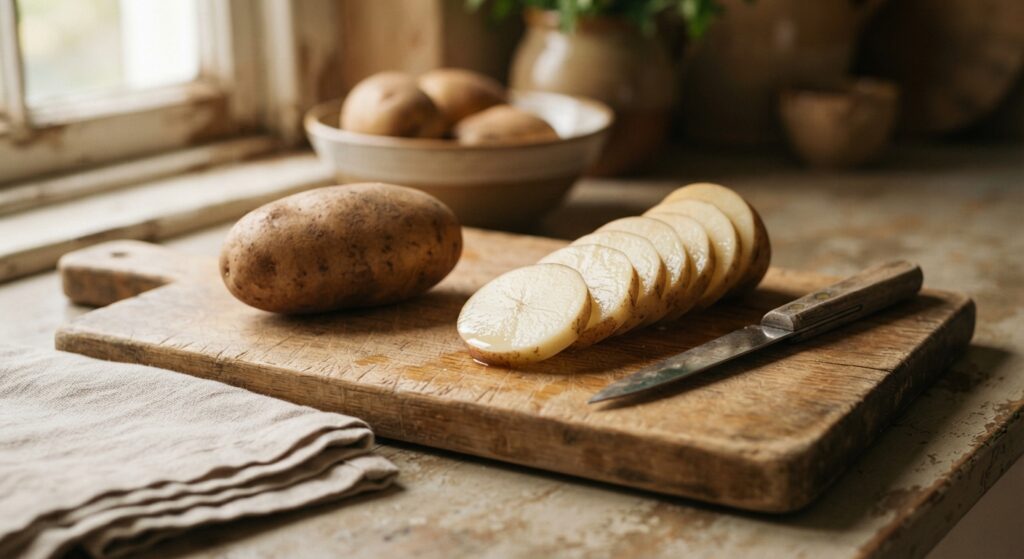
- Wash the potato well, then slice it into rounds about a quarter-inch thick. Chilling them briefly in the fridge makes them a touch more refreshing.
- Rest a slice on the forehead, the back of the neck, or the wrists, and swap it for a fresh one once it warms to skin temperature.
- For the feet, place a slice against each sole and hold it in place with a pair of cotton socks.
- Pair it with what actually helps a mild fever: rest, unhurried sips of water, and light clothing.
Because raw potato simply rests on intact skin, irritation is uncommon, but stop if the skin looks red or feels itchy, and do not use it over broken skin.
Safety and when to see a doctor
A fever is the body’s response to something, and the sensible job of a home comfort measure is never to hide it but to sit alongside proper attention. Seek medical care rather than relying on a compress if a fever is high, climbs steadily, or lasts more than a couple of days. Be especially careful with children: any fever in a baby under three months, a fever with a stiff neck, a rash that does not fade under gentle pressure, difficulty breathing, persistent vomiting, unusual drowsiness, or signs of dehydration all call for prompt professional help, not another slice of potato.
The honest bottom line
A cool potato slice is a harmless, pleasantly old-fashioned way to feel a little more comfortable when you are warm and run down. Think of it as a companion to rest and fluids, and to whatever care your situation calls for, rather than a remedy in its own right. Its charm is its humility, and its only real promise is a bit of quiet, steady coolness from the pantry.
This article is for general educational purposes only and is not medical advice. Traditional remedies are not a substitute for professional care. If your symptoms are severe, persistent, or getting worse, please consult a qualified healthcare provider.
Health disclaimer: This article describes a traditional folk remedy for general information only. It is not medical advice and is not a substitute for professional diagnosis or treatment. Some remedies can cause irritation, allergic reactions, or interact with medications. Consult a qualified healthcare professional before trying any remedy, patch-test anything applied to skin, and seek prompt medical care for severe, worsening, or persistent symptoms. See our full Medical Disclaimer.
The information on Kepoli is provided for general informational purposes only and is not professional medical, health, nutritional, or safety advice. Always use your own judgment and consult a qualified professional before acting on it.