Simple Techniques for Doughs and Bases
Master simple dough techniques using three levers: temperature, rest, and a light hand, with feel tests and fixes for tough pastry and dough that won't rise.

Dough felt like witchcraft to me for years, right up until I understood it only really answers to three things, and none of them is a secret ingredient. Whether you’re making flaky pie pastry, a loaf of bread, or a batch of cookies, the same handful of habits separates dough that behaves from dough that fights you. I’ve ruined versions of all three. Learn what your dough is actually reacting to and most of the guesswork disappears.
Jump to section
The three things every dough responds to
Before any specific recipe, three levers decide how a dough turns out:
- Temperature — whether your ingredients are cold or warm, and how warm the kitchen is.
- Rest — the time you give the dough to relax and hydrate before you work or bake it.
- Handling — how much you knead, press, and roll it.
Nearly every dough disaster I’ve ever caused — tough pastry, a loaf that flatly refused to rise, cookies that spread into one sad puddle — traces back to one of these three. Get them right and the recipe mostly takes care of itself.
Temperature: cold for pastry, warm for yeast
Temperature pulls dough in two opposite directions depending on what you’re making, and knowing which way yours wants to go solves most problems before they start.
Keep pastry cold
For pie crust, biscuits, and short pastry, cold is everything. I learned this the slow way, one summer when my kitchen ran warm and every crust I made came out dense and greasy no matter what else I changed. Solid, cold butter stays in distinct little pieces through mixing and rolling; in the oven, the water in that butter flashes to steam and pushes the dough apart into flaky layers. Let the butter soften first and it just blends into the flour, and you lose the layers entirely. Keep the butter fridge-cold, use ice water, and if your hands or your kitchen run warm, chill the dough between steps. The moment pastry starts to feel soft or sticky as you work, stop and put it back in the fridge for fifteen minutes.
Keep yeast dough warm, but not hot
Yeast is alive, and it works best with gentle warmth. If you’re proofing or dissolving yeast in liquid, aim for 100 to 110°F (38 to 43°C), comfortably warm to the touch, never hot. Liquid above roughly 130°F (54°C) starts killing the yeast, which is why a loaf made with water that felt “hot but fine” so often refuses to rise. I’ve killed yeast that way more than once, convinced the water was fine because my hand could stand it for a second. A finished bread dough is happiest rising somewhere around 75 to 78°F (24 to 26°C). A cold kitchen doesn’t ruin it; it just means the rise takes longer, so plan around that instead of fighting it.
Rest: let time do the quiet work
Resting is the most underused technique in home baking, because it looks like doing nothing. It isn’t. Some of my best loaves have come from dough I basically forgot about for an extra hour.
- Pastry needs to rest cold. After mixing, wrap short pastry and chill it for at least 30 minutes. That firms the butter back up and lets the flour fully hydrate, so the dough rolls out evenly instead of cracking and shrinking.
- Yeast dough needs to rise. The first rise, the bulk ferment, usually takes 1 to 2 hours at room temperature, until the dough has roughly doubled. This is where both structure and flavor develop.
- Bread benefits from an autolyse. Mix just the flour and water and let it sit 20 to 30 minutes before adding salt and kneading. The flour hydrates on its own, gluten begins to form, and the dough becomes noticeably easier to work.
- Rolled doughs relax, too. A 30-minute rest, wrapped at room temperature, lets the gluten in pasta or similar doughs settle so they stop springing back when you roll them.
Handling: a light hand usually wins
Working flour and water together develops gluten, the protein network that gives dough its stretch and chew. That’s exactly what you want in bread and exactly what you don’t want in tender pastry, so how much you handle a dough depends entirely on your goal.
For short pastry, biscuits, and pie crust, handle as little as you possibly can. Mix just until the dough comes together in a shaggy mass, then stop, even though every instinct says to keep smoothing it out. Overworking is the single most common reason pastry turns out tough; every extra squeeze builds more gluten and melts more butter.
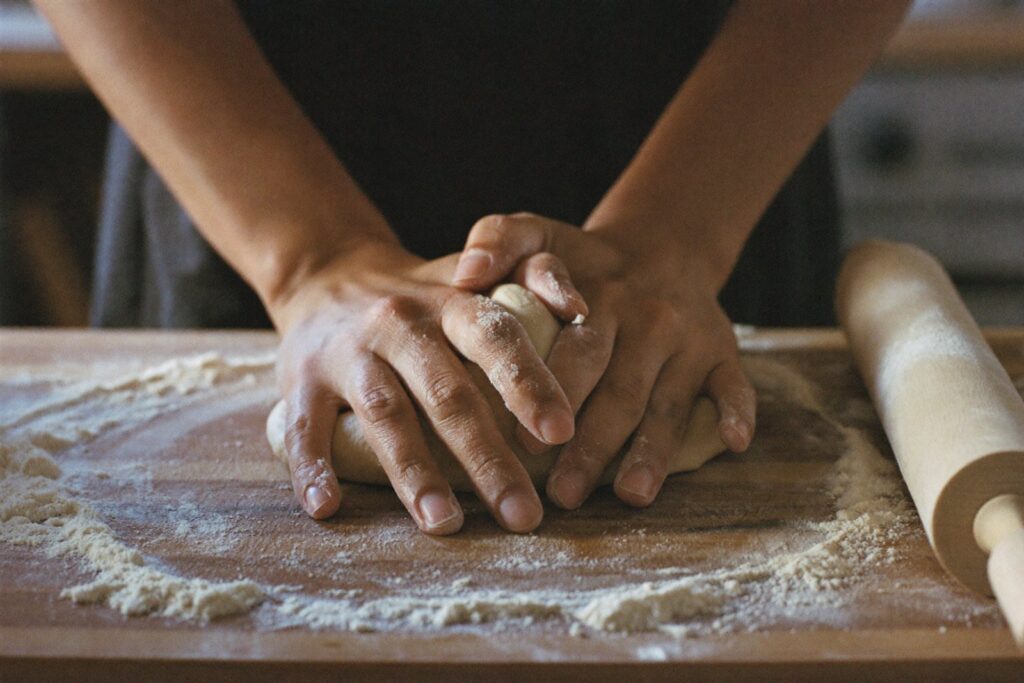
For bread, you want the opposite: enough kneading to build a strong, elastic network. By hand that’s usually 8 to 10 minutes of steady work. You’ll feel the dough change under your palms, from rough and sticky to smooth and springy, almost like a different substance entirely.
Learn to read the dough
Recipes give times, but real dough answers to your kitchen, your flour, and the weather. These are the checks I actually trust, more than any clock:
- The windowpane test (bread): stretch a small piece of kneaded dough thin. If it forms a translucent sheet without tearing, the gluten is developed and it’s ready.
- The poke test (proofed dough): press a fingertip gently into the risen dough. If the dent springs back slowly and only partway, it’s ready to bake. Springs back instantly? Give it more time. Doesn’t spring back at all? It has over-proofed.
- The look of pastry: it should hold together when pressed but still look a little rough, with visible flecks of butter. Smooth, uniform pastry has usually been overworked.
Fixing the usual problems
When a dough misbehaves, the cause is almost always one of the three levers:
- Pastry is tough or shrinks in the oven. Too much handling or too little rest. Work it less, and chill it longer before rolling and again after shaping.
- Yeast dough won’t rise. The liquid was too hot and killed the yeast, the yeast was old, or the room is simply cold and it needs more time. Salt poured straight onto yeast can also stall it, so mix the two in separately.
- Cookie dough spreads into puddles. The butter was too soft or the dough too warm. Chill it before it goes in the oven.
- Dough keeps springing back as you roll. The gluten is tight. Cover it, walk away for ten minutes, and it will roll out willingly.
Frequently asked questions
Why does my pastry turn out tough instead of tender?
Almost always too much handling, too little rest, or butter that got warm. Mix just until it comes together, keep everything cold, and give the dough at least 30 minutes in the fridge before you roll it out.
How do I know when yeast dough has risen enough?
Use the poke test. The dough should have roughly doubled, and a gentle press should spring back slowly and only partway. A cool kitchen simply means it needs more time, so judge by how the dough looks and feels rather than strictly by the clock.
Can I fix dough that keeps shrinking when I roll it?
Yes. Shrinking means the gluten is tense. Stop, cover the dough, and let it rest for ten to fifteen minutes so the gluten relaxes, then roll again; it will hold its shape.