How to Choose Fresh Ingredients
How to read produce, meat, fish, eggs, and dairy with your eyes, hands, and nose so you carry home the best of what's on offer, and how to store each thing so it lasts.


There’s a woman who sells fruit near where I grew up, and she once took a cantaloupe straight out of my hands. I’d chosen the prettiest one on the pile — smooth, evenly netted, not a bruise anywhere — and she turned it over, pressed the stem end to my nose, and waited. Nothing. No smell at all. Then she handed me one I’d have walked right past, a little soft where the vine had been, and it smelled like the whole of summer. That was the afternoon I stopped shopping with my eyes alone. Freshness, I’ve learned since, is something you read mostly with your nose and your hands — and the best-looking thing on the shelf is often the one with the least to say.
What your senses are actually checking for
Every check at the market is really a question, and each sense answers a different one. Your eyes look for damage and honest color. Your hands test for firmness and for heft — produce that feels heavy for its size is packed with juice and sugar rather than air. Your nose catches trouble first, well before anything looks wrong. When two signals disagree, trust the strongest, and if something smells off, leave it, however good it looks.
Produce: heavy for its size, firm, and honest about its smell
Fruit and vegetables give away almost everything if you handle them for a second before they go in the bag.
- Pick it up first. Something heavy for its size is full of water and sugar. Between two peppers or two oranges the same size, buy the heavier one nearly every time.
- Look for taut, unbroken skin. Wrinkles, dull patches, and soft spots are the plainest sign of age. A shriveled stem or a weeping bruise is the fruit telling you it’s past its best.
- Smell the stem end. Melons, tomatoes, peaches, and strawberries should smell like themselves where they were joined to the plant. No smell usually means no flavor — it was picked too early to catch up.
- Check that greens look alert. Lettuce, herbs, and leafy greens should stand up rather than flop. Limp leaves, slimy stems, or brown cut ends mean days on a shelf.
- Feel root vegetables for firmness. Potatoes, carrots, and onions should be hard with no give. Sprouting, soft spots, or a green tinge on potatoes all mean leave it.
Putting produce away so it lasts
- Not everything wants the fridge. Tomatoes, stone fruit, and bananas keep their flavor better on the counter; cold turns tomatoes mealy.
- Treat herbs like a bouquet. Stand tender herbs in a glass with a little water; wrap hardier ones in a barely damp cloth in the fridge.
- Keep greens dry. Moisture is what turns leaves to slime, so store them dry in a towel and wash only what you’re about to eat.
- Leave berries unwashed until you eat them. Rinsed too early, they go soft within a day.
- Store onions and potatoes apart. Cool, dark, and airy, but not side by side — each makes the other spoil faster.
Meat and poultry: firm, cold, and nearly odorless
With meat you’re reading three things at once — color, feel, and smell — and any one of them can tell you to walk away.
- Read the color, but know it shifts. Fresh beef is a deep red that darkens where it meets the air, and that browning alone is normal. A grey-green cast or a dull, tired look is not. Chicken should be pink and moist, never grey or sunken.
- Press for firmness. Good meat is firm and springs back. A surface that feels slimy or tacky is the first sign it’s turning.
- Trust your nose. Fresh meat and poultry smell almost of nothing. Any sourness or real “off” note means leave it behind, whatever the date says.
- Look for marbling. Those thin threads of white fat melt as it cooks, and they’re most of where flavor and tenderness live.
- Buy it cold and dry. A lot of liquid pooled in the package usually means it has been sitting.
Storing meat at home
Get it into the coldest part of the fridge as soon as you’re home — usually the bottom shelf, where it can’t drip onto anything below it. Keep it on a plate so nothing escapes onto other food, and cook it within a day or two or freeze it.
Fish and shellfish: it should smell like the sea, not “fishy”
Fish is where all of this matters most. It goes off fastest, and once you know the signs, it hides it least.
- Smell it first. Fresh fish smells clean and briny, like seawater or of almost nothing. A strong fishy or sharp, ammonia-like smell means it’s on its way out.
- Look at the eyes. On a whole fish they should be clear, bright, and slightly domed. Sunken, cloudy eyes are a giveaway of age.
- Lift the gills. They should be a vivid red or pink. Brown or grey gills mean it has been out of the water too long.
- Press the flesh. It should be firm and spring back, shiny rather than dull. On fillets, look for moist, translucent flesh with no dry edges or gaping.
- For shellfish, insist on alive. Mussels and clams should be closed, or close when you tap them; discard any that stay open.
Storing fish the moment you’re home
Fish doesn’t wait. Keep it in the coldest part of the fridge, ideally on a little ice, and cook it the same day or the next. If you can’t, freeze it straight away.
Eggs and dairy: a few checks that rarely fail
This is the easiest category to get right, because the tests are quick and the signals clear.
- Open the carton and look. Check every egg for cracks, and give the box a gentle tilt to make sure none are stuck to the bottom.
- Use the float test at home. A fresh egg sinks and lies on its side in a glass of water; an older one stands on end or floats as the air pocket inside grows. It’s a rough guide — if you’re unsure, crack it into a separate bowl, let your nose decide, and when in doubt, leave it.
- Smell milk and cream. Trust your nose over the printed date; a clean dairy smell is a better test than a number.
- Know how butter and cheese fail. Butter picks up a sharp, crayon-like smell when it turns; hard cheese with a little surface mold can usually be trimmed, while soft cheese that smells of ammonia is finished.
Where eggs and dairy belong
Keep eggs in the main body of the fridge rather than the door, where the temperature swings every time it opens, and leave them in their carton. Milk and the rest keep longest on a cold shelf toward the back.
Let the season choose for you
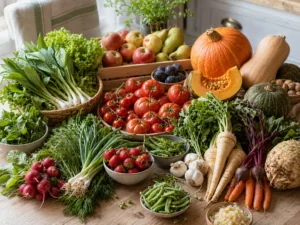
The surest shortcut to fresh, good-tasting food is to buy what’s in season. Produce picked in its own time hasn’t spent a week in transit, so it costs less and tastes like more — strawberries in June, tomatoes in late summer, apples and squash in autumn, hardy greens through the cold months. Out of season, the same items are shipped far and picked early, which is how you end up with a flawless-looking tomato that tastes of nothing.
Frequently asked questions
What if something looks perfect but smells slightly off?
Believe the smell. Appearance is the easiest signal to fake, while a sour or off smell is the earliest honest warning you get. If a thing smells wrong to you, leave it, whatever it looks like.
How do I judge fish that’s already filleted, with no eyes or gills to check?
Fall back on smell, look, and touch. A good fillet smells clean and of the sea, looks moist and almost translucent rather than dull and dry, and springs back when you press it. Drying edges, a grey film, or any sharp smell are reasons to choose another piece.
Is the egg float test something I can rely on?
Treat it as a hint, not the last word. It reads the size of the air pocket, which grows as an egg ages, so a floater is likely old — but the only real check is to crack it into a bowl and smell it. When you’re unsure, the cautious choice is to leave it.
The information on Kepoli is provided for general informational purposes only and is not professional medical, health, nutritional, or safety advice. Always use your own judgment and consult a qualified professional before acting on it.