Why Is There One Upside-Down Baluster on My Staircase? The Surprising Reason Behind This Old Tradition
You’ve invested weeks into renovations. The dust has settled. The paint is dry. The staircase — the centerpiece of your home — looks beautiful. And then…
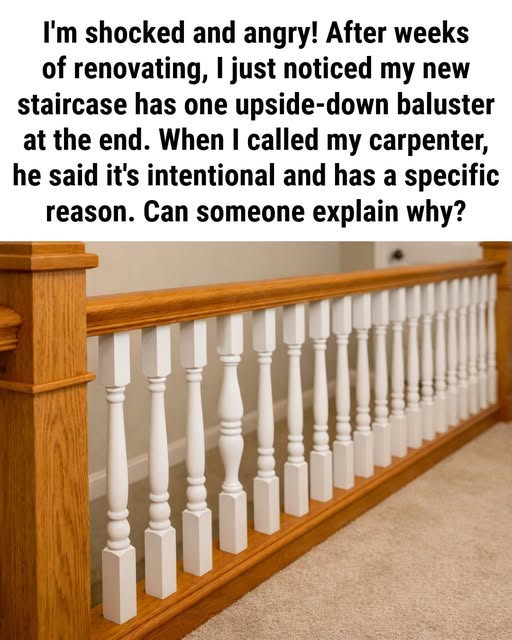
You’ve invested weeks into renovations. The dust has settled. The paint is dry. The staircase — the centerpiece of your home — looks beautiful. And then you see it.
One baluster. Upside down.
Naturally, you feel shocked. Maybe even angry. How could a skilled carpenter make such an obvious mistake?
But here’s the twist: in many cases, it’s not a mistake at all.
The “Intentional Flaw” Tradition
In certain woodworking traditions, especially those influenced by European craftsmanship, builders intentionally include a small imperfection in their work. This could be a reversed baluster, a subtle carving error, or a tiny asymmetrical detail.
Why?
Because of an old belief: only the divine is perfect.
For Complete Cooking STEPS Please Or Open button (>) and don’t forget to SHARE with your Facebook friends
By leaving a deliberate flaw, craftsmen symbolically acknowledge that human work should not attempt to rival perfection. It’s a quiet signature of humility — a reminder that craftsmanship is art, not machinery.
A Carpenter’s Signature
Some carpenters use subtle irregularities as a personal mark — especially in custom homes. Before modern branding or engraving tools were common, this was one way artisans left behind proof of their handiwork.
An upside-down baluster placed at the end of a staircase can function almost like a hidden signature. It says, “I built this.”
A Practical Reason (Yes, There’s One)
In some cases, especially at the end of a run, reversing one baluster can:
Mark the termination point of a railing section
Signal a transition in design
Prevent pattern repetition from looking too mechanical
Draw the eye subtly toward the staircase base
Designers sometimes introduce minor asymmetry to make handcrafted work feel more organic and less factory-produced.
It’s Not Always a Tradition
That said, not every upside-down baluster is symbolic. Occasionally, it really is an oversight. The key difference is intention. If your carpenter confidently said it was deliberate — and didn’t rush to fix it — there’s a strong chance it was part of the plan.
For Complete Cooking STEPS Please Or Open button (>) and don’t forget to SHARE with your Facebook friends
Before assuming negligence, ask:
Was this discussed in the design phase?
Does it match other subtle design choices?
Does it appear thoughtfully placed rather than random?
Should You Keep It?
That depends on how you feel about it.
Some homeowners grow to love the uniqueness once they understand the meaning. Others prefer uniformity and request a correction — which is perfectly reasonable in a custom renovation.
Remember: tradition explains the choice, but it’s your home.
The Bigger Perspective
What feels like a mistake may actually be craftsmanship philosophy at work. In a world of mass production and laser precision, a tiny human imperfection can be a quiet statement:
This was built by hands, not machines.
So before you demand it be replaced, consider this — that upside-down baluster might not be an error.
It might be a story.
You May Also Like
 My neighbor brought this to our block party in 1978 and I’ve been making it every summer since. Only 3 ingredients.
 Why Everyone Is Mounting Firewood Racks on Their Walls (And Why It’s the Coziest Home Trend Yet)
 5 vegetables you should never eat raw — they may hide worm nests that turn into parasites in your stomach
 How to Clean Black Mold from a Refrigerator Gasket in Minutes
Keep reading