Many People Still Think Those 2 Buttons Are Just for Flushing
You’ve seen them. Every modern bathroom has them. Two buttons on the toilet tank — one big, one small. And if you’re like most people, you might press…
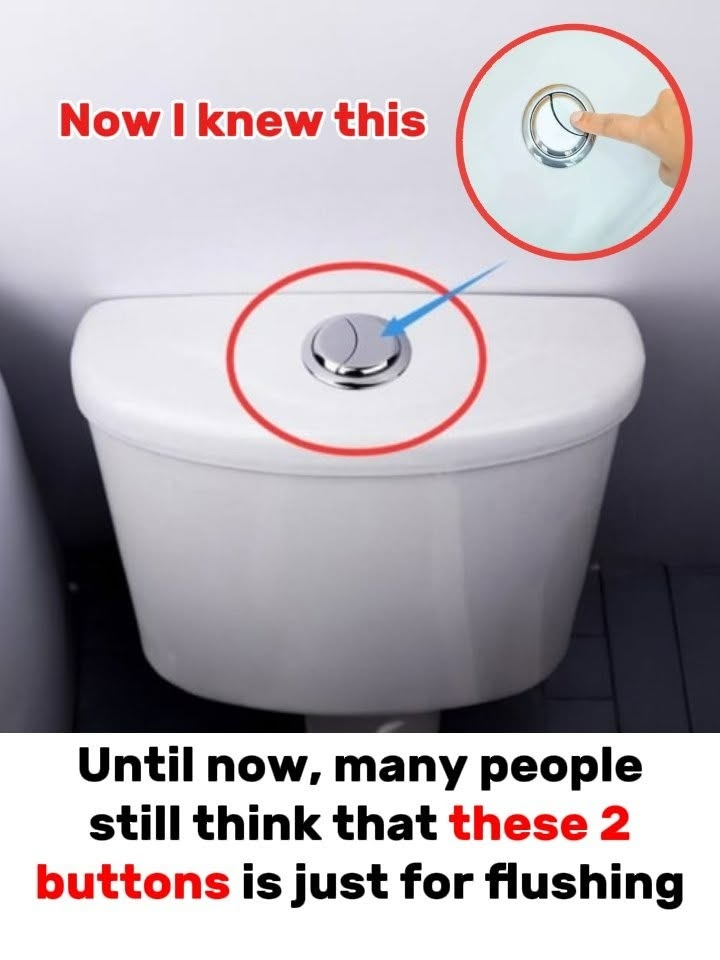
You’ve seen them.
Every modern bathroom has them.
Two buttons on the toilet tank — one big, one small.
And if you’re like most people, you might press both… or just one… without really thinking about it.
But here’s the truth:
👉 Those two buttons aren’t just design flair.
They’re part of a smart system called a dual flush toilet — one of the simplest ways to save water, cut bills, and reduce your environmental footprint.
Let’s break down how they actually work — so you can stop guessing and start saving.
Because real sustainability isn’t about grand gestures.
It’s about small choices — like which button you press. 💧
🔍 How Dual Flush Toilets Work (The Smart Way)
Dual flush toilets give you two flushing options — each designed for a different type of waste:
✅
Large Button (Full Flush)
For solid waste
~6–9 liters (1.6–2.4 gallons)
✅
Small Button (Half Flush)
For liquid waste
~3–4.5 liters (0.8–1.2 gallons)
💡 By choosing the right flush, you avoid using double the water when you don’t need to.
🔁 Pro Tip: If the half-flush doesn’t clear the bowl, wait 10 seconds and try again — don’t automatically hit both buttons!
💧 The Real Impact: Why This Matters
For Complete Cooking STEPS Please Or Open button (>) and don’t forget to SHARE with your Facebook friends
Toilets account for nearly 30% of indoor household water use — more than showers, sinks, and washing machines combined.
With a dual flush system, a family of four can save:
Up to 20,000 liters (5,300 gallons) per year
Around $100+ annually on water bills (depending on local rates)
Thousands of gallons over the life of the toilet
✅ That’s enough water to fill a backyard pool — every single year.
🌍 Environmental Benefits
Water is a finite resource.
And in many parts of the world — from California to Cape Town — droughts are becoming more frequent and severe.
Using a dual flush toilet helps:
Reduce strain on municipal water supplies
Lower energy used in water treatment and pumping
Minimize runoff and pollution from overloaded sewage systems
🌱 Every flush adds up.
Over time, this simple tech becomes a powerful act of conservation.
🛠️ A Quick History: Who Invented It?
While water-saving toilets evolved over time, the modern dual flush system was popularized in Australia in the 1980s — a country where droughts made water efficiency essential.
Though often credited to designer Victor Papanek for early eco-design concepts, the first commercial dual flush mechanism was developed by Australian company Caroma in 1980.
Since then, the design has spread worldwide — now standard in Europe, Japan, and green-certified homes everywhere.
❌ Common Mistakes People Make
Even with two buttons, many users miss the point. Watch out for these habits:
❌ Always pressing both buttons
Uses full flush every time — defeats the purpose
❌ Using the large flush for urine
Doubles water use unnecessarily
❌ Ignoring leaks
A running toilet can waste 200+ gallons/day — check dye tablets monthly
❌ Thinking “more flush = cleaner”
Modern toilets are efficient — trust the half-flush!
🔧 Bonus Tip: If your toilet runs after flushing, get it checked — worn flappers or seals cause silent leaks.
For Complete Cooking STEPS Please Or Open button (>) and don’t forget to SHARE with your Facebook friends
✅ Tips for Getting the Most Out of Your Dual Flush Toilet
Train everyone in the house
Kids, guests, roommates — teach the two-button rule
Post a small reminder sticker
“Small flush for #1, big flush for #2”
Clean the rim jets regularly
Buildup reduces flush efficiency
Choose WaterSense-labeled models
EPA-certified for performance and savings
📌 When replacing an old toilet, upgrading to dual flush can pay for itself in water savings within 2–5 years.
Final Thoughts
You don’t need a high-tech gadget to make a difference.
Sometimes, the most impactful green choice is already in your bathroom — quietly waiting for you to press the right button.
So next time you’re finishing up…
pause.
Choose wisely.
Because real change isn’t loud.
It’s quiet.
And sometimes,
it starts with a gentle push — not a splash.
And that kind of impact?
It flows far beyond your bathroom
You May Also Like
 My neighbor brought this to our block party in 1978 and I’ve been making it every summer since. Only 3 ingredients.
 Why Everyone Is Mounting Firewood Racks on Their Walls (And Why It’s the Coziest Home Trend Yet)
 5 vegetables you should never eat raw — they may hide worm nests that turn into parasites in your stomach
 How to Clean Black Mold from a Refrigerator Gasket in Minutes
Keep reading