Water Pie: A Great Depression Dessert From Almost Nothing
Discover water pie, the Great Depression dessert made from just water, sugar, flour, and butter. A thrifty, nostalgic old-fashioned recipe that still works.

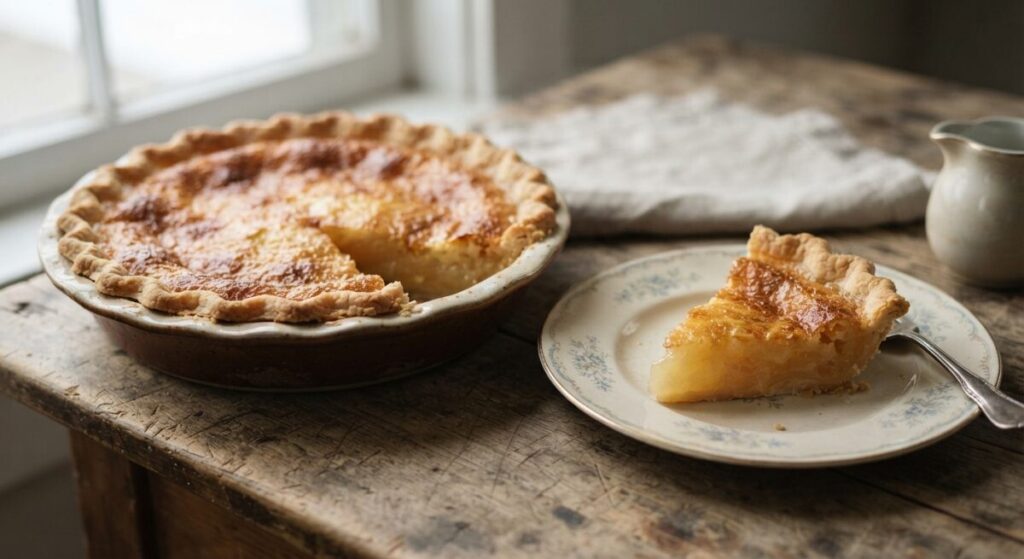
There’s a kind of kitchen alchemy that only makes sense once you’ve actually tasted it: a pie with almost nothing in it that still eats like dessert. Water pie is exactly that — a single crust filled with water, sugar, a little flour, a pat of butter, and a splash of vanilla, baked until the filling sets into something startlingly close to a custard. No eggs. No milk. No fruit. Just faith that heat and time could turn plain tap water into something worth serving after supper — and I’ll admit, the first time someone described this to me, I didn’t believe it would actually set.
Jump to section
For a family stretching every nickel through the 1930s, that faith was not optimism — it was necessity. When the pantry held flour, sugar, and butter but nothing else sweet to fill a pie, water pie was the answer: dessert conjured from what was already on the shelf, dressed up with a little vanilla and a lot of nerve.
The Story Behind It
During the Great Depression, sugar and flour were pantry staples that lasted, but fruit, cream, and eggs were often out of reach, especially in winter or for families far from a farm. A dessert built from water sounds like a joke today, but it was a genuinely clever solution: sugar dissolved in water and thickened with flour behaves remarkably like the custard base of a proper cream pie once it bakes inside a crust. The butter enriches it just enough, and the vanilla convinces your nose you’re eating something far richer than you actually are.
Recipes like this traveled by word of mouth and handwritten recipe cards, passed between neighbors and church suppers, precisely because they worked when nothing else was available. It wasn’t unusual for a mother to make water pie on a Sunday when there was flour and sugar in the tin but no money for a trip to the store. Kids who grew up eating it remember it fondly — not because it tasted exactly like apple or custard pie, but because it meant dessert was still possible, even when times were lean. That’s the real story behind water pie: it isn’t about the ingredients at all. It’s about refusing to let hardship cancel the small sweetness of an after-dinner treat.
Ingredients
- 1 unbaked 9-inch pie crust (homemade or store-bought)
- 1 3/4 cups water
- 1 cup granulated sugar
- 3 tablespoons all-purpose flour
- 3 tablespoons unsalted butter, cut into small pieces
- 1 1/2 teaspoons vanilla extract
- 1/4 teaspoon ground nutmeg or cinnamon (optional)
- Pinch of salt
How to Make It
- I preheat the oven to 350°F (175°C), fit the pie crust into a 9-inch pie plate, crimp the edges, and set it aside.
- In a small saucepan, I whisk the flour into about 1/4 cup of the water until it’s smooth with no lumps, then whisk in the remaining water.
- Add the sugar and salt to the saucepan and set it over medium heat. Cook, stirring often, until the mixture is steaming and just begins to thicken slightly, about 5 minutes — it won’t be thick like pudding yet, that happens in the oven.
- Remove from heat and stir in the butter until melted, then stir in the vanilla and nutmeg or cinnamon, if using.
- Pour the warm filling into the prepared crust.
- Bake for 45 to 55 minutes, until the top is golden brown in spots and the center has set with only a slight jiggle, similar to a baked custard.
- Cool the pie completely on a wire rack, at least 3 hours, before slicing — this is what lets the filling fully set. Chilling it in the refrigerator for an hour or two afterward makes it easier to cut, and I almost always do this, because three hours of patience is more than I usually have.
Tips, Swaps & Notes
Water pie sets the way it does because sugar and a small amount of flour, cooked together and baked, form a loose gel — much like the filling in a chess pie or a Southern sugar pie. The butter adds richness and helps the top brown, while a long, slow cool-down lets the starch finish thickening the filling from the inside out. Slice it too soon and it runs everywhere — ask me how I know — but give it the full resting time and it holds a clean edge, closer to a soft custard than a syrup.
A few swaps: add a tablespoon of lemon juice and a little zest for brightness, closer to a chess pie. Brown sugar in place of half the white sugar deepens the flavor toward butterscotch. For a firmer, more custard-like set, add one beaten egg to the cooled filling before pouring it into the crust — not traditional, but a common modern adaptation. The pie keeps well at room temperature for a day, but because of its simple filling it’s best stored covered in the refrigerator after that, and any version made with egg added should always be chilled. Serve it plain, or with a dusting of cinnamon, exactly as it would have been in 1933.
Why It Still Matters
Water pie endures because it tells the truth about resourcefulness: you don’t need abundance to make something worth sitting down for. It’s a reminder that a full pantry was never really the point — a little imagination and a warm oven were enough. Bake one, and you’re tasting a small act of hope that got a family through hard times, one slice at a time.
Some of the best desserts were never about having plenty — just about making do, and making it sweet anyway.
Water Pie: A Great Depression Dessert From Almost Nothing
Ingredients
- 1 unbaked 9-inch pie crust
- 2 cups water
- 1 cup granulated sugar
- 3 tablespoons all-purpose flour
- 3 tablespoons unsalted butter, cut into small pieces
- 1 teaspoon vanilla extract
- Pinch of salt
- Ground cinnamon, for topping
Instructions
- Preheat oven to 375°F. Fit the pie crust into a 9-inch pie plate and crimp the edges.
- In a saucepan, whisk together the sugar and flour, then whisk in the water until smooth.
- Bring to a gentle boil over medium heat, stirring constantly, until slightly thickened, about 3-4 minutes.
- Remove from heat and stir in the butter, vanilla, and salt until the butter melts.
- Pour the hot filling into the prepared crust and sprinkle with a little cinnamon.
- Bake 35-40 minutes, until the crust is golden and the filling is bubbling and starting to set.
- Cool completely on a wire rack, then refrigerate at least 3-4 hours to let the filling fully set before slicing.